
Who Are the Top 10 Butterfly Valve Manufacturers in China?
Choosing among China’s butterfly valve manufacturers takes more than comparing prices or catalogue photos. A valve may look simple on a screen, yet its seat, disc, stem, and coating affect performance in real service. Buyers should match these details to the medium, temperature, pressure, and operating frequency. Small differences matter.
This guide introduces ten manufacturers for readers assessing suppliers, product ranges, and potential fit. It is not a universal ranking: company capabilities, models, and delivery terms can change. A manufacturer’s stated certifications and test procedures should be checked against current documents, not assumed from a website. That extra step is worthwhile.
When comparing butterfly valves, ask for material specifications, pressure ratings, leakage-test information, and actuator options. Request drawings when installation space is tight, and confirm connection dimensions before ordering. For water, chemical, or process applications, compatibility deserves particular care. A neat brochure cannot answer every service question.
Supplier evaluation also means looking beyond the valve itself. Consider production capacity, inspection records, spare-parts support, and how clearly technical questions are answered. Factory visits or independent inspections may help when order size and risk justify them. Still, no checklist replaces application-specific engineering review. This overview offers a practical starting point, not a substitute for verification. Some details may be difficult to compare directly, and that is worth acknowledging. A careful shortlist is better than a confident guess.
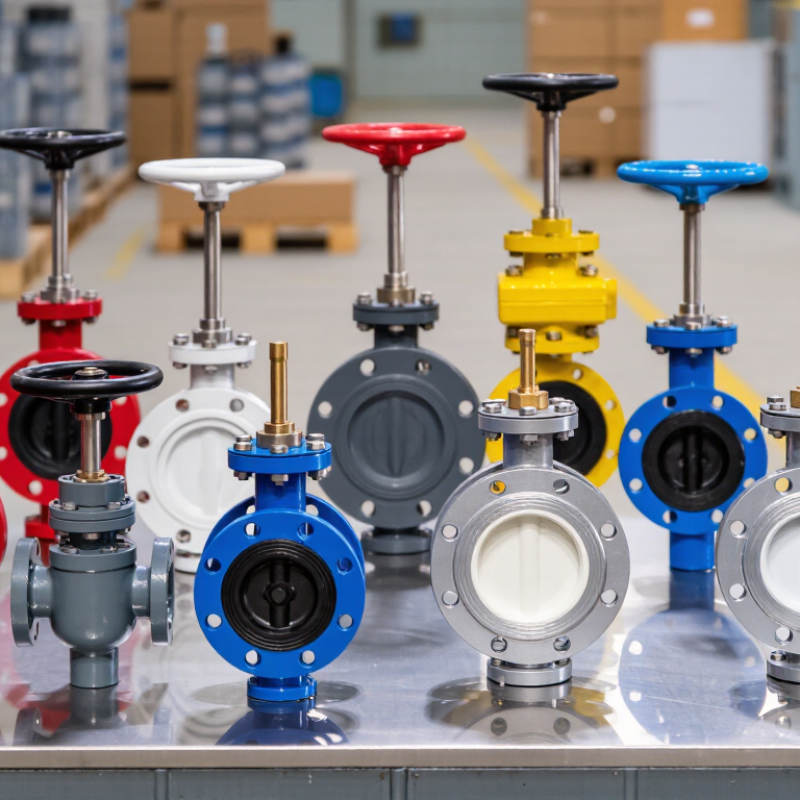
How Butterfly Valves Work and Where They Are Used
A butterfly valve controls flow with a circular disc mounted inside the pipe. A stem turns the disc about a quarter turn: open, it faces the flow; closed, it blocks the passage. Simple, but not trivial. The disc remains in the flow path, so it can affect pressure loss and flow patterns. Seat material, disc design, and operating pressure all matter. In practice, engineers check fluid temperature, corrosion risk, and required shutoff before selecting a valve.
These valves are common in water and wastewater networks, building HVAC systems, and large process pipelines. Their compact bodies and quick operation suit lines where space and frequent control matter. They can also regulate flow, but not every design performs well under continuous throttling. Sizing by pipe diameter alone can be a mistake. Grand View Research estimated the global industrial valves market at USD 78.6 billion in 2023 and projected 4.8% annual growth through 2030. That figure covers many valve types, not butterfly valves alone, but it reflects the broad demand for flow-control equipment. A field check should include actuator access and room to remove the valve for maintenance.
| No. | Manufacturer Evaluation Dimension | Factual Technical Information | Why It Matters / Typical Use |
|---|---|---|---|
| 1 | Operating principle | A butterfly valve uses a disc mounted on a shaft. Turning the shaft about 90 degrees moves the disc between open and closed positions. | Quarter-turn operation supports fast isolation and, with suitable designs and operating conditions, flow regulation. |
| 2 | Valve design range | Common designs include concentric (centered), double-offset, and triple-offset butterfly valves. | Design affects disc-seat contact, operating torque, sealing behavior, and suitability for different service conditions. |
| 3 | Seat and sealing materials | Seats may use elastomers or polymer materials, while metal-seated designs are also available. Suitability depends on the medium, temperature, pressure, and required leakage performance. | Material compatibility is important in water, chemical, steam, and process-fluid services; confirm limits for the specific valve. |
| 4 | Body and disc materials | Available material options can include cast or ductile iron, carbon steel, and stainless steel. The appropriate grade depends on corrosion, strength, and service requirements. | Material selection helps address corrosion, erosion, and mechanical loading in the intended installation. |
| 5 | End connections | Common connection styles include wafer, lug, and flanged bodies. Compatibility depends on the pipe flanges, bolting arrangement, and applicable dimensions. | The connection style affects installation, maintenance access, and whether the downstream pipe can remain supported when a section is removed. |
| 6 | Pressure and temperature rating | Allowable pressure and temperature are product-specific and depend on the body, seat, materials, and design. They should be checked against the manufacturer's published rating and project conditions. | There is no single pressure or temperature limit that applies to all butterfly valves. |
| 7 | Actuation options | Butterfly valves can be operated by a lever, gearbox, electric actuator, pneumatic actuator, or hydraulic actuator, depending on size and operating requirements. | Actuation choice depends on required torque, operating frequency, control system, and whether remote or automated operation is needed. |
| 8 | Applicable standards | API 609 covers butterfly valves; API 598 addresses inspection and testing of valves; ISO 5211 specifies mounting interfaces for part-turn actuator attachments. | Check the required standard and edition for the project; a standard reference does not by itself establish suitability for every service. |
| 9 | Inspection and documentation | A buyer can review pressure-test records, material documentation, dimensional information, and inspection procedures against the purchase specification. | Clear, traceable documentation helps verify that supplied valves match the specified design and materials. |
| 10 | Typical applications | Butterfly valves are used in water and wastewater systems, HVAC, fire-protection systems, and many industrial process lines when the selected design is suitable for the service. | Confirm fluid compatibility, operating conditions, leakage requirements, and applicable safety codes before selection. |
| This table provides a technical framework for comparing manufacturers and products; it does not present a ranked list or make unverified claims about individual companies. | |||
Related Posts
-
2026 Top Guide to Butterfly Valves for Global Buyers
-
7 Tips for Buying Butterfly Valves?
-

2026 Top Butterfly Valves at 139th Canton Fair Insights?
-

7 Best Butterfly Valves for Enhanced Industrial Performance in 2024
-

The Role of Butterfly Valves in Modern Industry: A Comprehensive Overview
-
China Top Foot Valve Manufacturers and Suppliers?