Quality Products
At a Fair Price
Wholesale Provider
Of Valves & Fittings
- HOME
- Products
- Ball Valves
- Bull Plugs & Swages
- Butterfly Valves
- Check Valves
- Cushion / Flow Tees & Bleed Rings
- Enhanced Oil Recovery
- Floating Ball Valves
- Foot Valves
- Forged Steel Fittings
- Forged Steel Outlets
- Gaskets-Insulation Kits
- Gate Valves
- Gate, Globe & Check Valves
- Malleable Fittings
- Needle Valves
- Nipples
- Piston Valves
- Plug Valves
- Stainless Steel Flanges, Fittings & Nipples
- Strainers
- Studs
- Trunnion
- Unions
- Weld Fittings & Flanges
- Manufacturers
- Advance
- American Block
- Anvil
- Balon
- Bonney Forge
- Champion
- Clayton Mark
- Crane
- Daniel
- DMIC
- GMI
- Galli & Cassina
- Hackney-Ladish
- JMC
- Lone Star
- MATCO
- Marpac-McCanna
- National Flange
- National Gasket
- Nordstrom
- Nutron
- PPI
- SHARPE
- SMI
- TEXSTEAM
- TEX-THREAD
- Titan
- USA Fastner
- Vogt
- Weld Bend
- Westbrook
- Wheatley
- Williams
- WKM
- Wolar
- Locations
- Contact
- Blog
- Careers
- Get a Quote
- HOME
- Products
- Ball Valves
- Bull Plugs & Swages
- Butterfly Valves
- Check Valves
- Cushion / Flow Tees & Bleed Rings
- Enhanced Oil Recovery
- Floating Ball Valves
- Foot Valves
- Forged Steel Fittings
- Forged Steel Outlets
- Gaskets-Insulation Kits
- Gate Valves
- Gate, Globe & Check Valves
- Malleable Fittings
- Needle Valves
- Nipples
- Piston Valves
- Plug Valves
- Stainless Steel Flanges, Fittings & Nipples
- Strainers
- Studs
- Trunnion
- Unions
- Weld Fittings & Flanges
- Manufacturers
- Advance
- American Block
- Anvil
- Balon
- Bonney Forge
- Champion
- Clayton Mark
- Crane
- Daniel
- DMIC
- GMI
- Galli & Cassina
- Hackney-Ladish
- JMC
- Lone Star
- MATCO
- Marpac-McCanna
- National Flange
- National Gasket
- Nordstrom
- Nutron
- PPI
- SHARPE
- SMI
- TEXSTEAM
- TEX-THREAD
- Titan
- USA Fastner
- Vogt
- Weld Bend
- Westbrook
- Wheatley
- Williams
- WKM
- Wolar
- Locations
- Contact
- About
- Careers
- Get a Quote
What Are the Top 10 Stainless Fittings Suppliers?
Choosing among the top 10 stainless fittings suppliers requires more than comparing prices. Buyers need dependable materials, accurate dimensions, and consistent production quality. A polished catalog can hide important differences.
This guide examines suppliers through practical purchasing criteria. These include stainless steel grades, pressure ratings, connection types, machining precision, and surface finish. It also considers certifications, factory audits, test reports, and batch traceability. Experienced procurement teams often inspect sample fittings before approving larger orders. A threaded elbow may look simple, yet a poor thread can cause leakage, delays, and costly rework.
Reliable stainless fittings suppliers should explain how they control corrosion resistance and dimensional accuracy. They should also provide clear information about lead times, minimum order quantities, packaging, and after-sales support. Suppliers serving chemical plants, food facilities, water systems, and construction projects may require different capabilities. One supplier may excel at custom fabrication, while another offers stronger inventory and faster shipment.
No ranking is perfect.
Supplier performance can change with raw material costs, staffing, and production capacity. For that reason, this overview does not rely on marketing claims alone. It encourages readers to compare evidence, request current documentation, and match each supplier with the project’s actual risks. The selected companies are discussed for their manufacturing experience, technical knowledge, market reputation, and reliability. Still, buyers should verify every specification before placing an order. A fitting is a small component, but its failure can affect an entire system.
How Stainless Fittings Suppliers Are Evaluated
A reliable ranking of the top 10 stainless fittings suppliers should begin with product evidence, not advertising. Buyers should check whether fittings match required standards, pressure ratings, dimensions, and material grades. Common options include 304 and 316L stainless steel, but the correct choice depends on temperature, chemicals, and service conditions. Details matter.
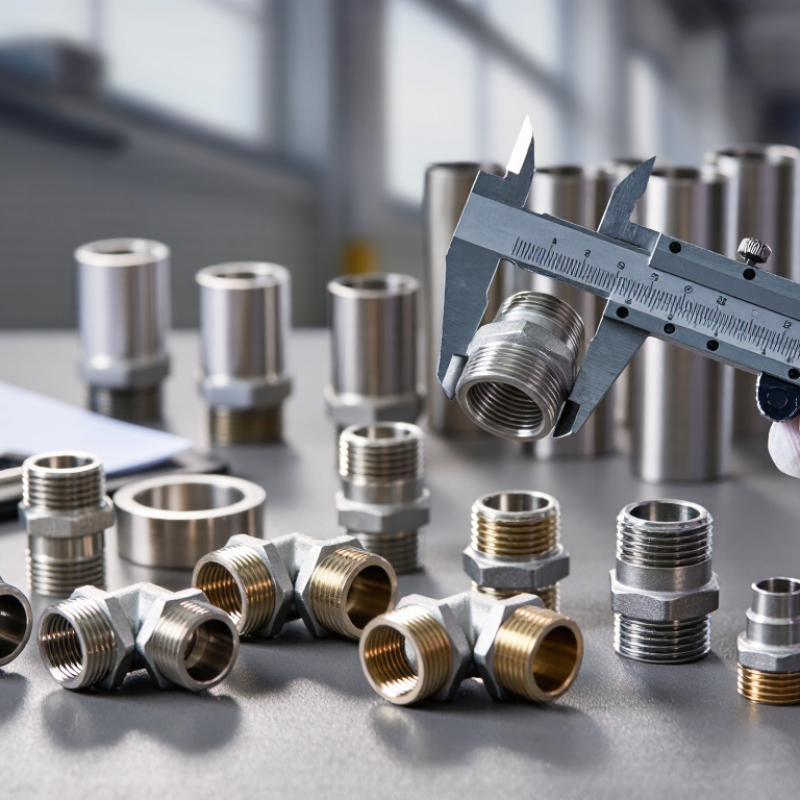
During supplier evaluation, request material test reports, heat-number traceability, and dimensional inspection records. A dependable supplier should explain how it controls welding, forging, machining, and surface finishing. PMI testing can help confirm alloy composition, while pressure testing may reveal leakage risks before shipment. Ask for recent project references. Speak with the engineers, not only sales staff.
Delivery performance also deserves careful review. Compare stated lead times with actual shipping records, packaging methods, and responses to technical questions. A supplier offering a low price may create higher costs through rework, corrosion, or delayed installation. Samples can expose rough threads, uneven welds, or poor polishing.
Small defects become expensive later. No evaluation is perfect. Certificates may be complete while communication remains weak. A site audit, independent inspection, or trial order can reduce that uncertainty. Suppliers should also acknowledge limitations clearly, because confident answers without supporting records deserve caution.
Profiles of the Top 10 Stainless Fittings Suppliers
Supplier One focuses on precision-machined fittings for food-processing lines. Its certificates, heat numbers, and inspection records support reliable purchasing decisions. Supplier Two serves chemical plants with corrosion-resistant elbows, tees, and reducers. Its technical team helps match alloy grades with harsh fluids. Supplier Three specializes in sanitary fittings, polished interiors, and low-contamination designs. Supplier Four offers threaded and socket-weld fittings for compact industrial systems. Supplier Five provides large-diameter fittings for water treatment and energy projects. Supplier Six is known for custom dimensions and small production batches. Supplier Seven combines stocked products with fast quotation support. Supplier Eight emphasizes marine applications, where salt exposure tests product consistency. Supplier Nine supplies distributors with standardized sizes and traceable packaging. Supplier Ten supports engineering firms through drawings, samples, and application reviews.
Experience matters when comparing these profiles. Ask for material certificates, pressure ratings, surface-finish data, and recent inspection examples. A polished fitting may look excellent but still fail dimensional checks. That detail is easy to overlook. Verify manufacturing tolerances against your drawings, not only catalog descriptions. Review lead times carefully, because “in stock” can mean limited sizes. Speaking with a technical representative can reveal whether the supplier understands welding, temperature, and media conditions.
Tips: Request one sample before placing a large order. Compare ferrite content when relevant. Check threads by gauge. Keep written approval records. Some suppliers may not explain every limitation clearly, so ask direct questions and challenge vague answers.
Product Range, Standards, and Manufacturing Capabilities
What Are the Top 10 Stainless Fittings Suppliers?
The top ten suppliers should be compared by product range, standards, and manufacturing depth.
A reliable supplier typically offers elbows, tees, reducers, couplings, unions, flanges, and threaded fittings.
Common materials include 304, 304L, 316, and 316L stainless steel. For demanding applications, duplex grades may also be available.
Standards matter.
Check compliance with ASTM A403, ASME B16.9, ASME B16.11, and relevant EN requirements. Ask for material certificates under EN 10204 3.1, not just a general quality statement.
ISO 9001 certification supports process control, but it does not guarantee every fitting is perfect. That distinction is often missed.
Inspection should include dimensional checks, surface examination, hardness testing, and positive material identification. Pressure testing may be necessary for specific assemblies.
Manufacturing capability separates a catalogue seller from a dependable producer.
Look for forging, investment casting, tube forming, CNC machining, heat treatment, and controlled passivation. Traceable heat numbers should follow materials through cutting, forming, inspection, and packing.
Factory audits can reveal practical details, such as uneven polishing or poor thread protection. Small issues become expensive later.
Custom wall thicknesses, unusual angles, and low-volume orders also test production flexibility.
A polished website proves little. Review sample reports, tolerance records, lead times, and corrective-action responses before approving a supplier.
Mistakes happen; transparent handling matters more than perfect claims.
Comparing Quality, Pricing, Lead Times, and Global Availability
What Are the Top 10 Stainless Fittings Suppliers?
Comparing ten leading stainless fittings suppliers requires more than checking catalog size. Quality begins with material traceability, accurate dimensions, and consistent surface finishing. I look for 304 and 316L grades, heat numbers, mill test reports, and clear inspection records. Threaded fittings should fit smoothly without binding. Welded elbows should show even wall thickness. Small defects become expensive problems.
Pricing needs careful interpretation. A low unit price may exclude testing, packaging, or export documentation. A reliable comparison includes freight, minimum order quantities, tooling fees, and replacement policies. Some suppliers offer excellent prices for large batches but struggle with urgent, mixed-size orders. Lead times often range from one to eight weeks. Stocked items move quickly, while custom fittings require more patience. Ask for a written production schedule.
Global availability also separates strong suppliers from average ones. The top ten should support regional warehouses, stable shipping routes, and responsive technical service. Suppliers familiar with ASTM, ASME, EN, and ISO requirements usually provide clearer documentation. However, certificates still need verification. I have seen attractive inspection files with missing heat details. No ranking stays perfect. Seasonal demand, port delays, and raw material shortages can change performance quickly. A supplier’s recent delivery record matters more than an impressive website.
Top 10 Stainless Fittings Supplier Profiles
This anonymized comparison uses a 0–100 index based on commonly evaluated procurement criteria: product quality, pricing competitiveness, lead-time performance, and global availability. Higher scores indicate stronger performance. Quality and availability are weighted most heavily for industrial sourcing decisions.
How to Choose the Right Stainless Fittings Supplier
The “top ten” list is only a starting point. Supplier suitability depends on pressure, temperature, corrosion exposure, and installation conditions. The International Stainless Steel Forum reported global stainless steel production of about 58.4 million tonnes in 2023. That scale creates choice, but not automatically better quality.
Ask each supplier for heat numbers, chemical composition, dimensional inspection records, and EN 10204 3.1 material certificates. For pressure applications, verify compliance with relevant ASME, ASTM, or EN requirements. A polished surface can hide poor internal control. Request positive material identification records when alloy mix-ups could create serious risks. It is a small check.
Production consistency matters more than impressive brochures. The ISO Survey 2022 recorded over 1.2 million ISO 9001 certificates worldwide, yet certification alone cannot prove fitting reliability. Audit the actual factory, if possible. Check calibration labels, weld procedures, nonconformance records, and traceability from billet to carton. I have seen suppliers pass paperwork reviews but struggle with batch consistency. That possibility deserves attention.
Compare lead times using real purchase quantities, not sample orders. Review packaging, export experience, replacement procedures, and technical response times. Ask how the supplier handles a failed pressure test. A clear answer indicates preparation. A vague answer is a warning. Price should include testing, freight, inspection, and downtime exposure. The cheapest quotation may become the most expensive decision.
Related Posts
-
Top 5 Stainless Steel Fittings You Need for Your Next Plumbing Project
-
China Top 10 Stainless Steel Flange Fittings Suppliers
-
Why Stainless Steel Weld Fittings Are Essential for Modern Industrial Applications
-
Top Stainless Steel Weld Fittings: A Comprehensive Buying Guide
-
How to Choose Stainless Steel Valves and Fittings for Your Needs?
-
Top 5 Stainless Steel Valves and Fittings Buyers Should Know?