
Quality Products
At a Fair Price
Wholesale Provider
Of Valves & Fittings
- HOME
- Products
- Ball Valves
- Bull Plugs & Swages
- Butterfly Valves
- Check Valves
- Cushion / Flow Tees & Bleed Rings
- Enhanced Oil Recovery
- Floating Ball Valves
- Foot Valves
- Forged Steel Fittings
- Forged Steel Outlets
- Gaskets-Insulation Kits
- Gate Valves
- Gate, Globe & Check Valves
- Malleable Fittings
- Needle Valves
- Nipples
- Piston Valves
- Plug Valves
- Stainless Steel Flanges, Fittings & Nipples
- Strainers
- Studs
- Trunnion
- Unions
- Weld Fittings & Flanges
- Manufacturers
- Advance
- American Block
- Anvil
- Balon
- Bonney Forge
- Champion
- Clayton Mark
- Crane
- Daniel
- DMIC
- GMI
- Galli & Cassina
- Hackney-Ladish
- JMC
- Lone Star
- MATCO
- Marpac-McCanna
- National Flange
- National Gasket
- Nordstrom
- Nutron
- PPI
- SHARPE
- SMI
- TEXSTEAM
- TEX-THREAD
- Titan
- USA Fastner
- Vogt
- Weld Bend
- Westbrook
- Wheatley
- Williams
- WKM
- Wolar
- Locations
- Contact
- Blog
- Careers
- Get a Quote
- HOME
- Products
- Ball Valves
- Bull Plugs & Swages
- Butterfly Valves
- Check Valves
- Cushion / Flow Tees & Bleed Rings
- Enhanced Oil Recovery
- Floating Ball Valves
- Foot Valves
- Forged Steel Fittings
- Forged Steel Outlets
- Gaskets-Insulation Kits
- Gate Valves
- Gate, Globe & Check Valves
- Malleable Fittings
- Needle Valves
- Nipples
- Piston Valves
- Plug Valves
- Stainless Steel Flanges, Fittings & Nipples
- Strainers
- Studs
- Trunnion
- Unions
- Weld Fittings & Flanges
- Manufacturers
- Advance
- American Block
- Anvil
- Balon
- Bonney Forge
- Champion
- Clayton Mark
- Crane
- Daniel
- DMIC
- GMI
- Galli & Cassina
- Hackney-Ladish
- JMC
- Lone Star
- MATCO
- Marpac-McCanna
- National Flange
- National Gasket
- Nordstrom
- Nutron
- PPI
- SHARPE
- SMI
- TEXSTEAM
- TEX-THREAD
- Titan
- USA Fastner
- Vogt
- Weld Bend
- Westbrook
- Wheatley
- Williams
- WKM
- Wolar
- Locations
- Contact
- About
- Careers
- Get a Quote
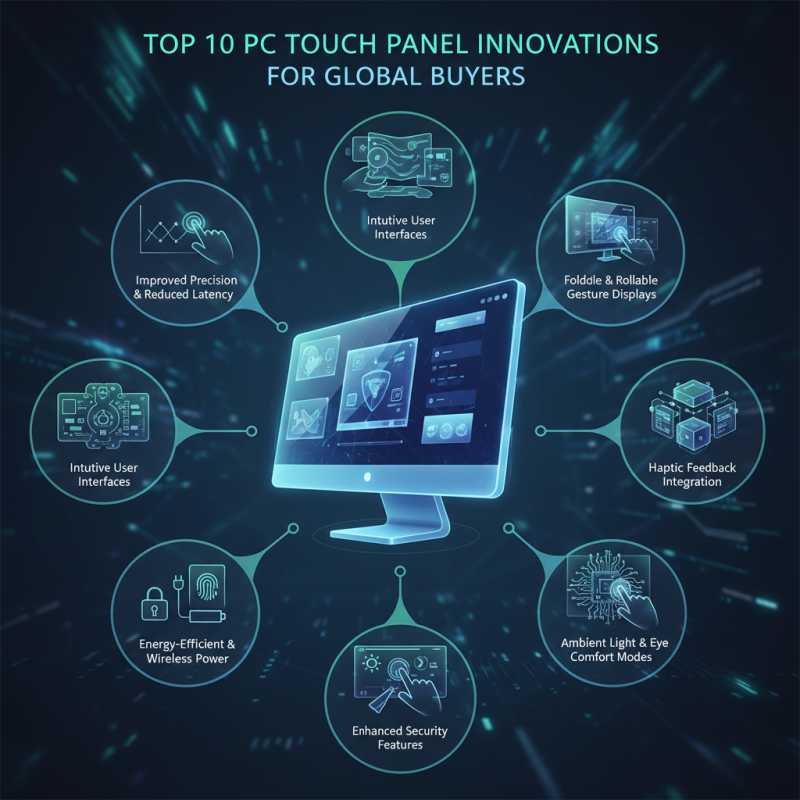
Top 10 PC Touch Panel Innovations for Global Buyers?
The evolution of the Pc Touch Panel industry is reshaping user interactions globally. According to Dr. Emily Zhang, a leading expert in touch technology, “Innovation in PC Touch Panels opens new avenues for intuitive user experiences.” This statement highlights the significant impact of touch technology in our daily computing tasks.
Recent advancements have introduced various PC Touch Panel innovations aimed at enhancing usability and accessibility. Users can now enjoy devices that blend responsiveness with sleek design. Many of these innovations focus on improving precision and reducing latency. However, the rapid changes can also lead to confusion over which technologies best fit individual needs.
While the progress is commendable, challenges remain. Companies must balance cutting-edge features with affordability. Some innovations may not fully address user requirements or expectations. The journey of PC Touch Panel development is ongoing, and industry professionals must continually refine their approaches for true user satisfaction.
Top 10 Touch Panel Technologies Revolutionizing PC Design
The evolution of touch panel technologies is reshaping PC design in innovative ways. One major advancement is the use of capacitive touchscreens. These panels provide a responsive user experience. They detect touch through electrical properties, allowing for multi-touch gestures. Users enjoy smoother interactions, like pinch-to-zoom. However, they can be less effective in outdoor settings, where sunlight creates visibility challenges.
Another significant innovation is the integration of haptic feedback. This technology simulates the sensation of touch. Users feel vibrations or clicks during interactions. It enhances engagement in gaming and design apps. Still, not all users appreciate this feature. Some find it distracting or unnecessary. The way forward involves striking a balance between feedback and user preference.
Optical touch technology is also transforming interactions. It uses cameras to detect users' gestures from a distance. This allows for a larger interactive space without touching the screen. Yet, practical applications are limited in small office settings. Precision can suffer if the workspace is cluttered. Therefore, while these developments boost creativity in PC design, reflection on usability is essential.
Emerging Trends in Touch Panel Features for Enhanced User Experience
The landscape of touch panel innovations is rapidly evolving, enhancing user experiences across devices. According to a report by MarketsandMarkets, the global touch panel market is expected to reach $33.5 billion by 2026, growing at a CAGR of 8.7%. Innovations in touch sensitivity and multi-touch capabilities are significant drivers of this growth. More responsive panels improve user interaction, making tasks simpler and faster.
Emerging trends emphasize advanced features like haptic feedback and gesture recognition. Haptic feedback creates a tactile response, making digital interactions feel more genuine. Meanwhile, gesture recognition technology enables users to control their devices with hand movements, reducing reliance on physical buttons. However, these technologies come with challenges. For instance, ensuring accurate gesture recognition in varied lighting conditions remains a critical hurdle.
Moreover, the integration of augmented reality (AR) capabilities in touch panels is gaining traction. AR overlays digital information onto the real world, enhancing user engagement. The technical complexity involved in developing reliable AR touch interfaces raises concerns regarding usability and accessibility. As innovations continue, the balance between cutting-edge features and practical application must be carefully navigated.
Top 10 PC Touch Panel Innovations for Global Buyers
| Innovation | Feature | User Benefit | Emerging Trend |
|---|---|---|---|
| Optical Touch Technology | Higher precision and responsiveness | Improved accuracy for detailed tasks | Growing application in design software |
| Multi-Touch Capability | Simultaneous touch recognition | Enhanced functionality for gaming and graphics | Increased demand in interactive applications |
| Anti-Glare Coating | Reduces reflections | Enhanced visibility in bright environments | Trend towards outdoor usability |
| Haptic Feedback | Physical response to touch | Enhanced user interaction experience | Increasing usage in mobile and PC hybrids |
| Gesture Recognition | Control without physical touch | Convenience and accessibility | Growing interest in smart environments |
| Wearable Touch Integration | Connects touch panels with wearables | Seamless seamless interaction across devices | Trend towards interconnected devices |
| Ultra-Slim Designs | Thin touch panels | Modern aesthetics and lightweight | Demand for sleek personal devices |
| Enhanced Capacitive Sensors | Improved response time and accuracy | Smoother touch performance | Shift towards premium touch experiences |
| Environmental Responsiveness | Adjusts settings based on surroundings | Optimized usability in varied conditions | Trend towards context-aware technology |
| Artificial Intelligence Integration | Smart interaction features | Personalized user experiences | Rapid growth of AI applications |
Comparative Analysis of Touch Panel Materials and Their Durability
When choosing touch panel materials, durability is a crucial factor. Many manufacturers analyze the lifespan and resilience of different materials under various conditions. For instance, data indicates that glass-based touch panels offer excellent scratch resistance, lasting up to 20 years with proper care. Yet, despite their strength, they are prone to shattering upon impact. This fragility is a significant concern for industrial applications.
On the other hand, plastic touch panels, while more flexible, tend to wear out faster. Reports show that they can last around 5 to 10 years in high-use environments. However, they are more susceptible to scratches and discoloration over time. Comparative studies reveal that hybrid materials may provide a balanced solution. They combine the durability of glass with the flexibility of plastic, potentially extending the product life to 15 years. Yet, this hybrid approach can sometimes lead to manufacturing complexities.
User feedback highlights another consideration. Some users prefer tactile feedback, which may not be as pronounced in certain materials. This feedback can enhance user experience, making it essential to consider the application when selecting materials. Balancing durability, cost, and user preference remains a challenge for designers and manufacturers alike.
Integration of AI and Touch Panel Interfaces in Modern PCs
The integration of AI into touch panel interfaces is transforming modern PCs. Users now experience smoother interactions through intuitive gestures. Imagine hovering a finger over a screen, and the AI recognizes your intent. It predicts actions accurately, enhancing productivity and user satisfaction.
However, the technology is not flawless. Users may find occasional inaccuracies in gesture recognition. Misinterpretation can lead to frustration, especially during critical tasks. Furthermore, the reliance on AI raises concerns about privacy. Users often wonder how their data is processed and stored.
Despite these challenges, the advancements are significant. Touch panels now offer multi-layered functionalities, enabling creative workflows. Designing applications that leverage AI in touch interfaces can open new possibilities. Yet, it’s crucial for developers to address user feedback and improve reliability over time. The journey of merging AI and touch technology is ongoing, with much to learn and adapt.
Future Prospects and Innovations in Touch Panel Technology for PCs
The future of touch panel technology for PCs shows promising potential for innovation. Research indicates that by 2025, the global touch screen market is projected to reach $40 billion, driven by advancements in user interactivity and design. Enhanced sensitivity and accuracy will redefine user experiences in both professional and personal realms.
Tips for designers: prioritize ergonomics. A well-placed touch panel can improve workflow efficiency. Many users report discomfort with poorly designed interfaces. Focusing on user-centered design can mitigate these issues.
Emerging technologies like haptic feedback and gesture recognition are crucial. These features promise to create immersive interactions. According to the latest industry reports, 57% of users value these enhancements for daily tasks. However, integration remains a challenge, and testing is essential. Ensuring that these innovations do not complicate usability is vital for success.
