
Quality Products

At a Fair Price

Wholesale Provider

Of Valves & Fittings

  • Corporate Office: 1301 Greengrass Drive Houston, TX 77008
  • 1-800-237-2512

Quality Products

At a Fair Price

Wholesale Provider

Of Valves & Fittings

Top Kitchen Faucet Accessories OEM Suppliers?

Choosing a kitchen faucet is no longer just a matter of finish. Buyers also compare spray heads, hoses, mounting hardware, adapters, and replacement cartridges. The National Kitchen & Bath Association’s 2024 Kitchen Trends Report tracks changing priorities in kitchen design, while Grand View Research’s kitchen faucet market analysis examines market growth and product demand. Together, these sources offer useful context for sourcing, though neither should be treated as a direct ranking of accessory manufacturers.

That distinction matters. A polished faucet can still disappoint if its hose kinks, its spray head feels flimsy, or replacement parts are difficult to obtain. For brands and importers, a reliable Kitchen Faucet Accessories Oem partner should demonstrate material consistency, clear quality-control procedures, and the ability to match parts to specific faucet models. Ask for drawings, sample units, and documented inspection criteria. Small details count.

The data has limits. Market reports rarely reveal how long an accessory lasts in an ordinary home, or how smoothly a supplier handles a late design change. That gap deserves attention. This guide examines OEM suppliers through practical factors, including product range, customization, testing, communication, and lead-time transparency. It is not a substitute for factory audits or hands-on sample checks. Real testing still matters.
Top Kitchen Faucet Accessories OEM Suppliers?

Understanding Kitchen Faucet Accessories and OEM Supply

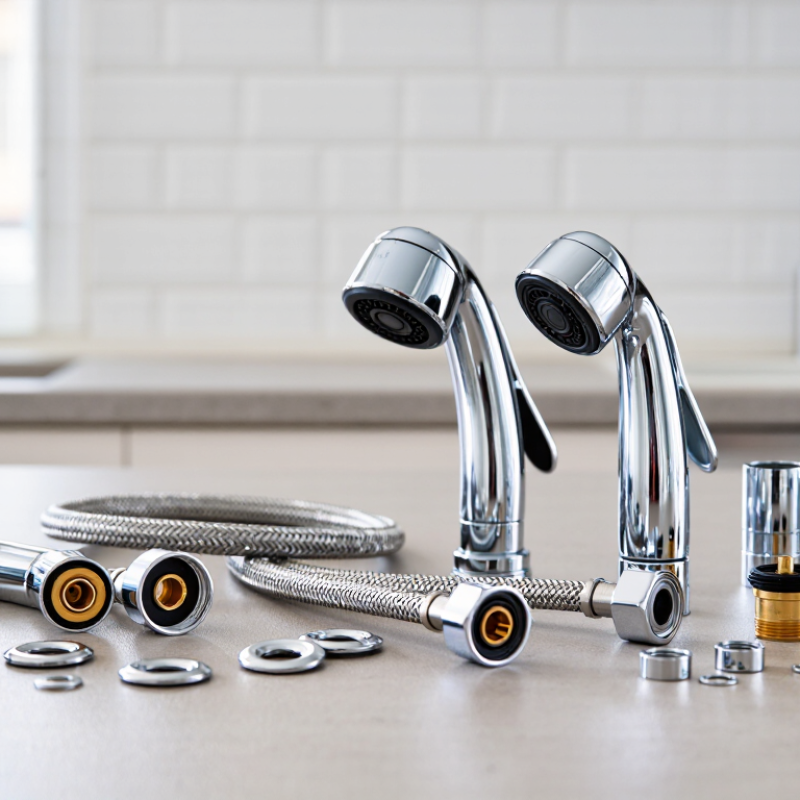
Kitchen faucet accessories are small parts with outsized effects: a spray head that drips, a hose that kinks, or a loose mounting plate can undermine an otherwise solid faucet. OEM supply means these components are produced to a buyer’s drawings, specifications, and compatibility requirements. Typical items include pull-down sprayers, cartridges, aerators, hoses, escutcheons, and mounting kits.

The U.S. Department of Energy’s faucet efficiency standards set a maximum flow rate of 2.2 gallons per minute for kitchen faucets at 60 psi. That figure gives buyers a clear test reference, but it does not describe spray quality or performance at lower household pressure.

For sourcing, request dimensional drawings, material declarations, pressure-test records, and samples from the intended production line. Check hose reach under a real sink, not only on a clean showroom bench. Ask how the supplier controls thread tolerances and replacement-part consistency across batches. These details matter when a distributor stocks spare parts or a manufacturer assembles faucets in another country.

Small parts matter.

A polished sample is not proof of stable production; I would want repeat samples and documented inspection criteria before approving a large order. The NKBA’s 2024 Kitchen Trends Report tracks changing kitchen preferences, but OEM buyers still need their own product tests: trend data cannot confirm that a diverter will survive repeated switching.

Common Accessories Offered by Kitchen Faucet OEM Suppliers

Common accessories from kitchen faucet OEM suppliers include pull-down spray heads, flexible hoses, counterweights, aerators, mounting kits, deck plates, soap dispensers, and replacement cartridges. Some suppliers also offer side sprayers and inline filter connections. Small parts matter. A hose that kinks under a deep sink, or a spray head that drips after switching modes, can undermine an otherwise solid faucet. OEM buyers should check thread dimensions, finish consistency, cartridge compatibility, and whether replacement parts remain available.

The Grand View Research Kitchen Faucets Market report estimated the global market at about US$8.5 billion in 2023, with projected growth through 2030. That market context makes accessory reliability commercially important, though it does not measure accessory demand directly. For sampling, test spray patterns at different pressures and inspect hose retraction with a full sink cabinet beneath the counter. Ask suppliers for material specifications and documented cycle-test results, not just attractive product photos. I would still question any claim of “universal” fit: small differences in hose connections or mounting thickness can create costly installation problems.

How OEM Suppliers Design and Manufacture Faucet Accessories

OEM suppliers begin with the faucet’s actual use, not just a catalog drawing. They map spray patterns, grip clearance, hose routing, and countertop space before shaping a spray head or aerator. A few millimeters can decide whether a pull-down head docks cleanly. Small parts matter.

Engineers then select materials for water exposure, heat, and repeated movement. Stainless steel, engineering polymers, and elastomer seals each behave differently under pressure. Suppliers typically prototype parts, check fit with the faucet body, and test spray switching and hose retraction. The U.S. Department of Energy sets a 2.2-gallon-per-minute maximum flow rate for kitchen faucets at 60 psi (10 CFR 430.32). That figure makes flow testing important: an accessory can change the delivered stream even when the faucet body stays unchanged.

Production quality depends on more than a successful prototype. OEM teams use dimensional checks, pressure tests, and cycle tests to catch leaks or loose connections before shipment. ASME A112.18.1/CSA B125.1 provides plumbing-fixture performance requirements used across the industry. Still, a test fixture cannot reproduce every sink depth or user habit. Suppliers should review field feedback and revise molds, seals, or spray geometry when recurring issues appear. Small adjustments can prevent frustrating drips.

Top Kitchen Faucet Accessories OEM Suppliers? - How OEM Suppliers Design and Manufacture Faucet Accessories

Accessory Design Considerations Common Materials Typical Manufacturing Processes Quality Checks OEM Project Deliverables
Faucet aerator Outlet thread compatibility, flow pattern, splash control, and ease of cleaning. Flow performance must suit the faucet design and target market. Brass or stainless-steel housing; polymer screens; elastomer seals. Metal turning or molding, screen and insert assembly, thread finishing, and surface treatment where specified. Thread and fit checks, visual inspection, leakage checks, and flow-pattern or flow-rate testing against the approved specification. Approved dimensions, thread details, material declarations, sample approval, and agreed inspection criteria.
Pull-down or pull-out hose Length, bend flexibility, connection type, resistance to kinking, and compatibility with the faucet’s retraction system. Common constructions use an elastomer or thermoplastic inner tube, a textile or metal reinforcement layer, and metal end fittings. Tube extrusion, reinforcement braiding or covering, end-fitting assembly, and crimping or other specified joining operations. Connection and dimensional checks, leakage testing, and flexibility or durability tests using project-defined conditions. Hose construction details, fitting drawings, material information, approved samples, and traceability requirements.
Spray head Spray-mode selection, button operation, water distribution, ergonomic grip, and secure connection to the hose. Engineering polymers, stainless steel, or brass, with elastomer seals; material choice depends on design and finish requirements. Injection molding for polymer parts; machining or forming for metal parts; assembly of valves, seals, and spray inserts. Mode-switch function, fit and finish, leakage, and spray performance checks against the approved product specification. Part drawings, finish samples, assembly requirements, functional test plan, and packaging specifications.
Mounting hardware Compatibility with the sink or countertop thickness, faucet shank, available installation space, and tool access. Stainless steel, brass, plated steel, or engineering polymers, depending on load, corrosion, and cost requirements. Stamping, turning, threading, molding, and assembly of washers, nuts, brackets, or stabilizing plates. Thread engagement, dimensions, assembly fit, visual condition, and corrosion-related checks where required by the specification. Hardware drawings, material and finish requirements, installation instructions, and packing configuration.
Soap dispenser Bottle capacity, refill access, pump stroke, countertop-hole fit, and compatibility with the intended liquid soap. Polymer or metal pump components, a polymer reservoir, and elastomer seals; selected materials should suit the intended fluid and use conditions. Injection molding, metal forming or machining, pump assembly, and bottle or reservoir production. Pump operation, dispensing consistency, leakage, fit, and compatibility checks using the specified liquid and test method. Capacity and dimensional requirements, pump specifications, material information, approved samples, and user instructions.
Filter or water-line adapter Connection standard, flow direction, sealing method, available installation space, and compatibility with the specified filtration system. Brass, stainless steel, or approved engineering polymers with suitable elastomer seals. Machining or molding, thread formation, deburring, cleaning, and assembly with seals or fittings. Connection fit, leakage, flow direction marking, and material or performance verification required for the destination market. Connection drawings, seal specifications, material documentation, installation details, and market-specific compliance records where applicable.

Note: These are common design and manufacturing approaches, not fixed specifications for every product. Exact dimensions, materials, finishes, flow rates, test pressures, and acceptance limits should be defined in the buyer’s approved drawings and the requirements of the destination market.

Key Criteria for Evaluating Kitchen Faucet Accessory Suppliers

When comparing OEM kitchen faucet accessory suppliers, look beyond catalog breadth. Ask for dated drawings, material declarations, and dimensional tolerances for aerators, pull-down hoses, adapters, and mounting kits. Request samples from a regular production lot, not polished display pieces. Small differences matter.

Check how suppliers verify flow, leakage, corrosion resistance, and hose-cycle durability. The U.S. EPA’s WaterSense specification for residential bathroom faucets sets a 1.5-gallon-per-minute limit, at least 30% below the 2.2-gpm federal baseline. This is a useful efficiency reference, not a kitchen-faucet requirement. Ask suppliers to test accessories under the flow and pressure conditions your kitchen product actually needs. Numbers need context.

Also examine change control and replacement-part support. Can the supplier trace a material or tooling change to a specific production lot? Can it provide a replacement hose or cartridge years later? These answers reveal more than a low sample price. A useful, imperfect shortcut is to compare the first sample with a second production batch; one sample cannot show consistency. Review packaging, installation instructions, and compatibility notes too. A connector that looks right may still leak after repeated movement. Supplier claims deserve written evidence.

How to Select an OEM Partner for Your Business

A reliable OEM partner should prove process control, not just offer an attractive catalogue. Ask for material specifications, component drawings, and test records for each accessory, including pull-down sprayers, hoses, aerators, and soap dispensers. Request a pre-production sample and inspect its fit, spray pattern, finish, and connection points. Small defects show up quickly on a wet countertop.

Market context matters. Houzz’s 2024 U.S. Kitchen Trends Study reported that median spending on major kitchen remodels reached $55,000 in 2023, up 20% from 2022. That signals real investment, but it does not mean every accessory needs a premium finish. Compare quotations by material grade, tooling fees, minimum order quantity, lead time, and warranty terms. Then verify capacity through a factory audit or live production review. Ask how the supplier checks coating thickness and tests hose connections across production batches. A polished sample is useful, but it cannot prove consistent mass production. I would also question unusually short lead times; sometimes the missing detail is the quality-control step. Define change approvals, packaging requirements, and defect remedies in writing before placing an order.

Top
error: Content is protected !!