Quality Products

At a Fair Price

Wholesale Provider

Of Valves & Fittings

  • Corporate Office: 1301 Greengrass Drive Houston, TX 77008
  • 1-800-237-2512

Quality Products

At a Fair Price

Wholesale Provider

Of Valves & Fittings

China Top Valve Fittings Manufacturers How to Choose?

Choosing China’s top valve fittings manufacturers is not a simple search for the lowest quotation. It is a technical decision involving pressure, temperature, media, standards, delivery, and long-term service. The phrase “valves fittings” covers many products, including ball valves, gate valves, check valves, pipe fittings, and custom assemblies. Each application demands different materials and testing methods.

A dependable manufacturer should provide clear drawings, material certificates, pressure-test records, and traceability documents. Ask how stainless steel, carbon steel, brass, or special alloys are inspected before production. Request evidence of ISO systems, relevant product certifications, and previous supply experience in your industry. A factory visit can reveal machining accuracy, assembly discipline, storage conditions, and testing equipment. Look beyond polished catalogs.

Details matter.

A strong supplier also communicates technical limits honestly. It should explain pressure ratings, sealing choices, coating performance, and lead-time risks without vague promises. Customer references can help, but they should be checked carefully. A neat factory tour may still hide weak subcontractor control. No checklist is perfect. Even experienced buyers can overlook corrosion conditions or installation differences. Therefore, manufacturer selection should combine documented evidence, practical engineering review, sample inspection, and small-batch verification. This approach may require more time, but it reduces costly failures after shipment. It also creates a more reliable basis for comparing China’s leading manufacturers and choosing a partner that can support consistent quality, safe operation, and future technical changes.
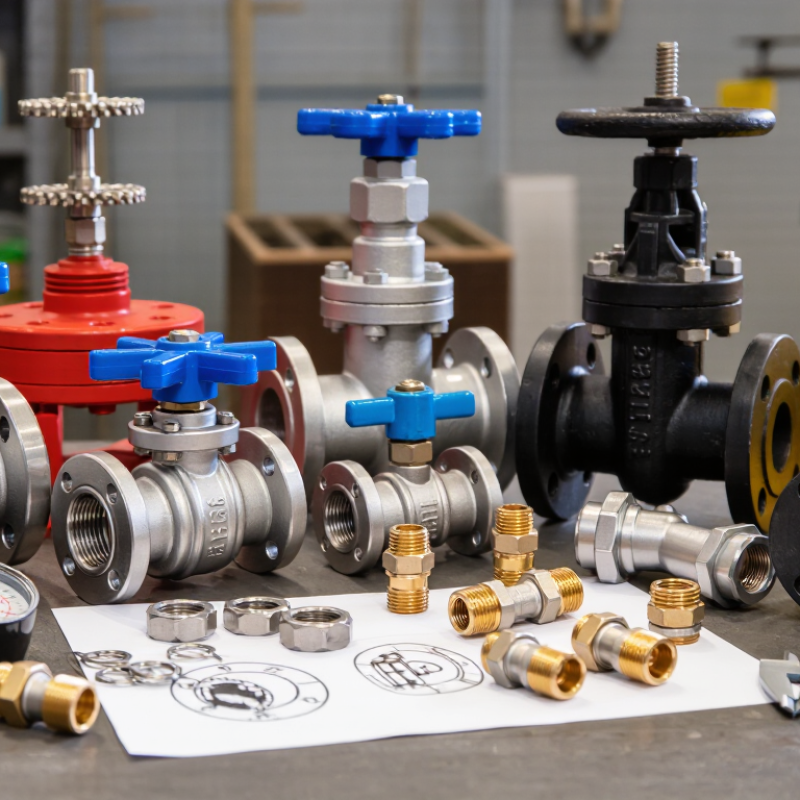
China Top Valve Fittings Manufacturers How to Choose?

Understanding China’s Valve Fittings Manufacturing Industry

China’s valve fittings industry is more than a low-cost sourcing base. It combines casting, forging, machining, testing, and export logistics within one dense manufacturing network. The scale is substantial. MarketsandMarkets’ 2024 Industrial Valves Market report values the global market at about USD 78.8 billion in 2024. It projects USD 97.4 billion by 2029. This demand raises expectations for Chinese suppliers. Buyers should examine process control, not only quoted prices. A practical audit follows the metal from heat-number records to final pressure testing. Small details matter. Check machining marks, gasket surfaces, thread accuracy, and test certificates.

Grand View Research reports continued industrial valve growth through 2030. Water treatment, energy, chemicals, and infrastructure remain major demand sectors. This growth explains China’s broad supplier base, but quality can vary sharply. Some factories excel at ductile iron bodies. Others perform better with stainless steel, forged parts, or custom actuation. Ask for material traceability, calibrated equipment, hydrostatic testing, pneumatic procedures, and nonconformity records. Confirm testing against relevant ISO, API, or ASME requirements. Certificates alone are insufficient. Witness a live inspection when possible.

A serious comparison should include production capacity, mold ownership, minimum order quantities, lead-time history, and service response. Request recent inspection reports, not selected photographs. Review dimensional tolerances and coating thickness. Communication during technical changes also reveals maturity. A polished brochure is not evidence. Many evaluations reward low price before lifecycle cost. That is a mistake. A cheaper fitting may cause leakage, downtime, and replacement labor. The strongest manufacturer is not always the largest. It is the supplier whose documented process matches the project’s pressure, medium, temperature, and compliance requirements.

China Valve Fittings Manufacturing: Typical Material Temperature Capability

Material selection is a key factor when choosing a valve fittings manufacturer. The chart shows indicative service-temperature ranges commonly associated with major valve and fitting materials. Actual limits depend on grade, pressure rating, media, design standard, and certification.

Stainless steel generally provides the widest temperature range, while PVC is mainly used for lower-temperature, corrosion-resistant applications. Buyers should verify the manufacturer’s material certificates, pressure tests, dimensional standards, and application-specific operating limits.

Key Types of Valve Fittings and Their Industrial Applications

Key Types of Valve Fittings and Their Industrial Applications

Selecting valve fittings requires more than comparing prices. Threaded fittings suit low to medium pressure lines, especially instrument air and water systems. Flanged fittings support frequent maintenance in refineries, power plants, and chemical facilities. Butt-weld fittings reduce leakage risks on high-pressure steam and process pipelines. Socket-weld designs work well where compact connections and clean flow paths matter. For food and pharmaceutical systems, sanitary fittings need smooth internal surfaces and easy cleaning.

Industry data shows why this choice matters. Grand View Research valued the global industrial valves market at about USD 78 billion in 2023, with continued growth expected through 2030. The International Energy Agency also reports that industry remains a major source of global energy demand. More process equipment means more connection points, and small fitting failures can stop large systems. That assumption fails.

When evaluating China-based manufacturers, request material certificates, pressure-test records, dimensional reports, and traceability from raw bar to shipment. Check compatibility with standards such as ASME B16.5, ASME B16.9, API 6D, or ISO 5211, depending on the application. A stainless-steel fitting may still corrode if chloride exposure, temperature, or welding quality is ignored. Inspectors should examine thread accuracy, flange faces, weld penetration, and gasket seating. Field audits often reveal inconsistent markings or incomplete records. That is uncomfortable, but useful. A reliable supplier should explain these weaknesses instead of hiding them.

China Top Valve Fittings Manufacturers How to Choose? - Key Types of Valve Fittings and Their Industrial Applications

Selection guide based on commonly used international standards, material properties, pressure ratings, and industrial service conditions.
Valve Fitting or Connection Type Typical Materials Common Size Range Typical Pressure or Class Range Applicable Standards Suitable Media and Industrial Applications Key Selection Criteria
Threaded Fittings Carbon steel, stainless steel, ductile iron, brass DN6–DN100
(1/8–4 in)
Approximately 150–3,000 psi, depending on material and design ASME B1.20.1, ISO 7-1, ASME B16.11 Compressed air, water, instrumentation, low-to-medium pressure oil and gas service Check thread form, sealing method, corrosion resistance, and allowable working pressure. Avoid threaded joints where vibration or frequent thermal cycling is severe.
Socket-Weld Fittings Forged carbon steel, alloy steel, stainless steel DN6–DN100
(1/8–4 in)
Class 300, 600, 900, 1,500 and 2,500 ASME B16.11, ASME B16.34 Steam, high-pressure water, process piping, chemical and power-generation systems Provides a compact, strong joint. Confirm welding procedure requirements, pipe schedule, material compatibility, and inspection requirements.
Butt-Weld Fittings Carbon steel, stainless steel, duplex stainless steel, alloy steel DN15–DN1,500
(1/2–60 in)
System-dependent; commonly used in high-pressure and high-temperature piping ASME B16.9, ASME B16.25, EN 10253 Refineries, petrochemical plants, power stations, transmission pipelines, and large-diameter process lines Offers low flow resistance and a permanent joint. Select wall thickness, weld-end preparation, corrosion allowance, and material grade according to the piping design.
Flanged Connections Carbon steel, stainless steel, alloy steel, ductile iron DN15–DN2,000
(1/2–80 in)
ASME Class 150–2,500; PN6–PN420 in EN systems ASME B16.5, ASME B16.47, EN 1092-1 Water treatment, oil and gas, chemical processing, HVAC, marine systems, and equipment connections Choose flange face, pressure class, gasket material, bolt grade, and bore alignment. Flanged joints are preferred where disassembly and maintenance are required.
Wafer-Style Valve Connections Ductile iron, carbon steel, stainless steel, aluminum bronze DN25–DN1,200
(1–48 in)
Commonly PN6–PN25 or ASME Class 150 EN 593, API 609, ASME B16.34 Cooling water, fire protection, water distribution, HVAC, and general industrial fluid control Lightweight and economical, but installation requires correct flange alignment and sufficient clearance. Verify lug or wafer configuration and disc clearance.
Lug-Style Valve Connections Ductile iron, carbon steel, stainless steel DN50–DN1,200
(2–48 in)
Commonly PN10–PN40 or ASME Class 150–300 API 609, EN 593, ASME B16.34 Process isolation, water treatment, chemical lines, and systems requiring one-sided pipe removal Permits independent bolting to each flange and may support dead-end service when specifically designed for it. Confirm the manufacturer’s end-of-line pressure rating.
Grooved Couplings and Adapters Ductile iron, carbon steel, stainless steel DN25–DN600
(1–24 in)
Often up to approximately 300 psi, subject to coupling design AWWA C606, UL 213, FM requirements where applicable Fire-protection piping, building services, chilled water, and retrofit or temporary piping systems Fast installation with limited hot work. Verify groove dimensions, gasket compound, pipe wall thickness, seismic requirements, and fire-system approvals.
Compression Fittings Brass, stainless steel, copper, engineering polymers Approximately 4–28 mm tubing
(up to about 1 in in selected systems)
Application-specific; instrumentation versions may support high pressures ISO 8434, DIN 2353, ASTM standards for tubing materials Instrumentation, hydraulic control lines, pneumatic systems, laboratory equipment, and sampling lines Match fitting type to tube outside diameter, wall thickness, hardness, and media. Proper tube preparation and tightening are essential to prevent leakage.
Flare Fittings Brass, copper, stainless steel Approximately 6–22 mm tubing
(1/4–7/8 in common in HVAC)
System-dependent; commonly used in refrigeration and light hydraulic service SAE J512, SAE J513, ISO 8434 variants Refrigeration, air-conditioning, fuel, gas, and small hydraulic tubing systems Confirm flare angle, tube material, refrigerant or gas compatibility, vibration resistance, and required pressure-temperature rating.
Sanitary Clamp Fittings 316L stainless steel, elastomers such as EPDM, PTFE, or silicone DN10–DN300
(1/2–12 in)
Generally low-to-medium pressure; temperature depends on gasket and process design ASME BPE, ISO 2852, 3-A sanitary principles where required Food and beverage, pharmaceutical, biotechnology, cosmetics, and hygienic water systems Prioritize surface finish, drainability, crevice reduction, gasket compatibility, clean-in-place capability, and certification requirements.
High-Pressure Hydraulic Fittings Carbon steel, stainless steel, zinc-nickel coated steel Approximately 6–50 mm tubing
(1/4–2 in)
Often 3,000–10,000 psi; some specialized systems are higher ISO 8434, ISO 6162, SAE J514 Mobile hydraulics, industrial presses, injection molding, construction equipment, and hydraulic power units Check working and burst pressure, impulse rating, tube compatibility, vibration, coating, and contamination-control requirements.
Expansion Joints and Flexible Connectors EPDM, nitrile rubber, PTFE, stainless steel bellows, fabric-reinforced elastomers DN25–DN2,000
(1–80 in)
Commonly low-to-medium pressure; temperature and movement limits are design-specific EN 14917, EJMA guidance for metal bellows, application-specific standards Pumps, HVAC, cooling-water systems, process equipment, and pipelines subject to vibration or thermal movement Evaluate axial, lateral, and angular movement; media compatibility; temperature; vacuum resistance; anchor and guide requirements; and fatigue life.
Lined or Plastic Valve Fittings PTFE-lined steel, PVC, CPVC, PP, PVDF DN15–DN600
(1/2–24 in)
Usually low-to-medium pressure; temperature depends strongly on polymer type ASTM D1784, ASTM D2467, ISO 16138, application-specific lining standards Acids, alkalis, ultrapure water, corrosive chemical dosing, semiconductor, and water-treatment systems Prioritize chemical resistance, permeation, UV exposure, temperature derating, joint method, and compatibility between valve body, lining, and gasket.
Strainers and Filter Fittings Cast iron, carbon steel, stainless steel, bronze DN15–DN600
(1/2–24 in)
Commonly PN10–PN40 or ASME Class 150–300 ASME B16.34, EN 16767, manufacturer-specific design standards Pump protection, steam, cooling water, compressed air, process fluids, and chemical systems Select mesh or perforation size, filtration area, pressure drop, drain arrangement, basket material, and clean-out access.
Practical selection checklist: Define the fluid, operating temperature, normal and maximum pressure, nominal size, connection standard, corrosion conditions, flow direction, maintenance requirements, applicable certifications, and required testing before comparing suppliers or requesting quotations.

How to Evaluate Chinese Valve Fittings Manufacturers

How to Evaluate Chinese Valve Fittings Manufacturers

A reliable evaluation starts with verifiable production evidence. Request the factory’s business license, quality certificates, and recent audit records. Confirm whether production occurs in-house or through undisclosed subcontractors. Visit the facility when possible. Observe machining areas, assembly lines, storage conditions, and calibration labels. A clean showroom proves little. The workshop tells more.

Technical capability must match your valve fittings requirements. Review material grades, pressure classes, connection standards, temperature ranges, and surface treatments. Ask for heat numbers and material certificates for each batch. Check whether inspectors perform dimensional checks, hydrostatic tests, and leakage tests. Request sample inspection reports, not only prepared brochures. Ask for evidence. Details matter.

Experience with international shipments is also important. Examine packaging methods, export documents, inspection procedures, and response times during technical discussions. A dependable manufacturer should explain tolerances clearly and admit known limitations. Perfect answers can be suspicious. I once found that a supplier with excellent samples had inconsistent batch labeling, creating serious traceability concerns. Request a pilot order before signing a large contract. Compare sample results with mass-production results, delivery records, corrective actions, and after-sales communication. Price deserves attention, but unexplained savings may reflect weaker materials, testing, or inspection. Keep written records of every requirement. Mistakes happen, and vague agreements make them expensive.

Quality Standards, Certifications, and Production Capabilities

Choosing a China valve fittings manufacturer requires more than checking price or polished catalogs. The ISO Survey 2022 recorded 1,265,216 ISO 9001 certificates worldwide, showing how common quality certification has become. It is only a starting point. Ask for the certificate scope, audit date, and production site address. Then verify whether it covers valve design, machining, assembly, and testing.

Technical compliance should match the application. Pressure-boundary valves may require testing under API 598, dimensional control under ASME B16.34, and material traceability through EN 10204 inspection documents. Request heat numbers, chemical reports, pressure-test records, and calibration certificates. A serious factory should explain its hydrostatic test pressure clearly. Vague answers deserve attention. In practice, missing records often create more risk than visible machining defects.

Production capability also needs evidence. A 2024 MarketsandMarkets forecast estimated the industrial valve market could grow from about USD 78.4 billion in 2024 to USD 99.8 billion by 2029. Rising demand can encourage rushed capacity expansion. Check CNC equipment, casting sources, welding procedures, inspection staff, and spare-part controls. Review sample products from raw material to final packing. Factory visits help, but they are not perfect. A clean workshop can still hide weak process control. Independent inspection before shipment remains a sensible safeguard.

Comparing Prices, Services, and Long-Term Supplier Value

China Top Valve Fittings Manufacturers: How to Choose?

Price comparisons should begin with identical specifications, not headline quotes. The Grand View Research Industrial Valves Market Report valued the global market at about USD 74.7 billion in 2022. It forecasts a 4.8% compound annual growth rate through 2030. This growth increases supplier choices, but also creates more inconsistent quotations.

Request body material, pressure class, connection type, testing scope, and coating details. A lower quote may exclude hydrostatic testing, certificates, spare seals, or export packaging. Ask for a sample inspection record. Check dimensional reports against applicable standards, such as ISO 5208 or API 598, when relevant. Small omissions become expensive later. I have seen “complete” offers change after the first drawing review.

Service quality deserves a measurable score. Compare engineering response time, drawing approval speed, traceability, and warranty handling. The World Bank’s Logistics Performance Index 2023 shows that international delivery reliability remains uneven across markets. Therefore, evaluate realistic lead times, not optimistic promises. Calculate total supplier value using purchase price, freight, inspection, downtime risk, maintenance parts, and replacement time. A supplier with a slightly higher price may reduce shutdown exposure. Still, the calculation is imperfect. Forecasts can miss currency movements, port delays, or changing project requirements. Request three years of quality records, customer references in similar applications, and a written escalation process before signing.

Top
error: Content is protected !!