
Quality Products
At a Fair Price
Wholesale Provider
Of Valves & Fittings
- HOME
- Products
- Ball Valves
- Bull Plugs & Swages
- Butterfly Valves
- Check Valves
- Cushion / Flow Tees & Bleed Rings
- Enhanced Oil Recovery
- Floating Ball Valves
- Foot Valves
- Forged Steel Fittings
- Forged Steel Outlets
- Gaskets-Insulation Kits
- Gate Valves
- Gate, Globe & Check Valves
- Malleable Fittings
- Needle Valves
- Nipples
- Piston Valves
- Plug Valves
- Stainless Steel Flanges, Fittings & Nipples
- Strainers
- Studs
- Trunnion
- Unions
- Weld Fittings & Flanges
- Manufacturers
- Advance
- American Block
- Anvil
- Balon
- Bonney Forge
- Champion
- Clayton Mark
- Crane
- Daniel
- DMIC
- GMI
- Galli & Cassina
- Hackney-Ladish
- JMC
- Lone Star
- MATCO
- Marpac-McCanna
- National Flange
- National Gasket
- Nordstrom
- Nutron
- PPI
- SHARPE
- SMI
- TEXSTEAM
- TEX-THREAD
- Titan
- USA Fastner
- Vogt
- Weld Bend
- Westbrook
- Wheatley
- Williams
- WKM
- Wolar
- Locations
- Contact
- Blog
- Careers
- Get a Quote
- HOME
- Products
- Ball Valves
- Bull Plugs & Swages
- Butterfly Valves
- Check Valves
- Cushion / Flow Tees & Bleed Rings
- Enhanced Oil Recovery
- Floating Ball Valves
- Foot Valves
- Forged Steel Fittings
- Forged Steel Outlets
- Gaskets-Insulation Kits
- Gate Valves
- Gate, Globe & Check Valves
- Malleable Fittings
- Needle Valves
- Nipples
- Piston Valves
- Plug Valves
- Stainless Steel Flanges, Fittings & Nipples
- Strainers
- Studs
- Trunnion
- Unions
- Weld Fittings & Flanges
- Manufacturers
- Advance
- American Block
- Anvil
- Balon
- Bonney Forge
- Champion
- Clayton Mark
- Crane
- Daniel
- DMIC
- GMI
- Galli & Cassina
- Hackney-Ladish
- JMC
- Lone Star
- MATCO
- Marpac-McCanna
- National Flange
- National Gasket
- Nordstrom
- Nutron
- PPI
- SHARPE
- SMI
- TEXSTEAM
- TEX-THREAD
- Titan
- USA Fastner
- Vogt
- Weld Bend
- Westbrook
- Wheatley
- Williams
- WKM
- Wolar
- Locations
- Contact
- About
- Careers
- Get a Quote
How to Choose Granite Air Bearings for Global Sourcing?
Choosing granite air bearings for global sourcing is not simply a matter of comparing prices. The decision affects motion accuracy, machine stability, delivery risk, and long-term maintenance. A suitable supplier must explain load capacity, air consumption, stiffness, granite grade, surface flatness, and operating conditions in clear technical documents. Vague answers deserve caution.
Professor Alexander H. Slocum, a respected precision-machine designer, wrote, “The best machine is the simplest machine that meets the requirements.” This principle is valuable when evaluating granite air bearings. A bearing designed for a clean laboratory may fail in a factory with dust, vibration, or unstable air pressure. Buyers should match the bearing to the actual application, not an idealized specification sheet.
Global sourcing adds practical details. Check packaging methods for a 200-kilogram granite assembly. Confirm inspection procedures before shipment. Ask whether the supplier can provide calibration records, dimensional reports, replacement components, and responsive engineering support. Lead time matters, but so does traceability. One missing tolerance can delay installation for weeks.
A spreadsheet can look complete and still hide a costly gap. That is the uncomfortable part. Supplier claims should be tested against drawings, samples, and independent measurements whenever possible. Compare total ownership cost, not only the purchase price. Freight, customs handling, commissioning, air filtration, and downtime may change the final result. The strongest sourcing decision combines engineering evidence with realistic factory experience. No checklist is perfect. Careful questions remain essential.
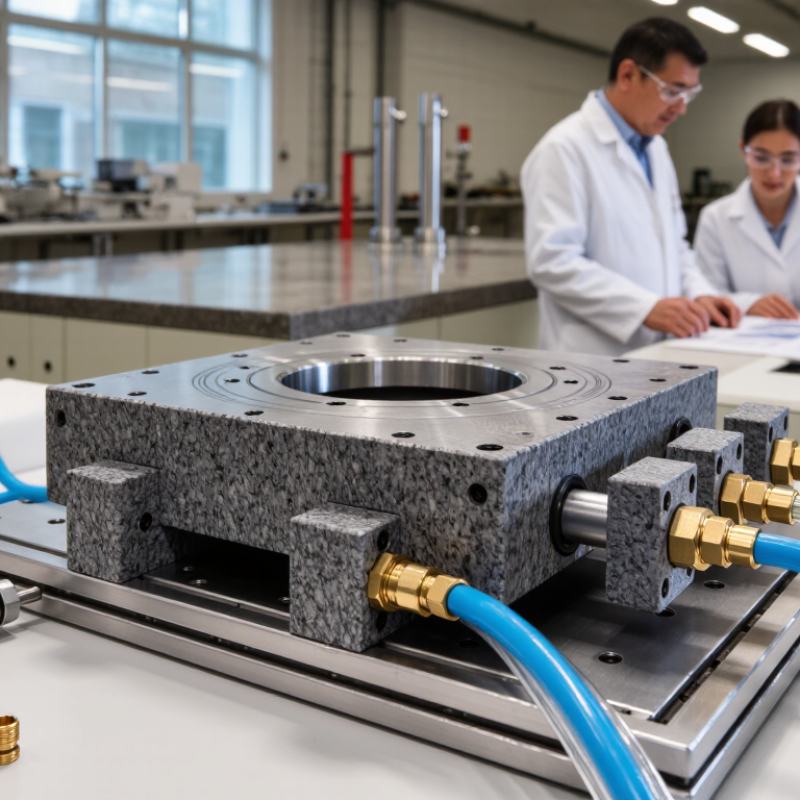
What Granite Air Bearings Are and How They Function
How to Choose Granite Air Bearings for Global Sourcing?
Granite air bearings support precision stages on a thin film of compressed air. Air passes through fine restrictors or porous surfaces, creating near-frictionless separation. The granite base provides stiffness, thermal stability, and useful vibration damping. It also resists corrosion and keeps its geometry under demanding laboratory conditions.
The U.S. Department of Energy’s Improving Compressed Air System Performance sourcebook reports that leaks can waste 20–30% of compressor output. That figure is not universal, but it exposes a frequent sourcing mistake: selecting the bearing before checking air quality and consumption. ISO 8573-1 should guide particulate, water, and oil requirements. Ask suppliers for load capacity, stiffness, flatness, flow rate, operating pressure, and temperature limits. Request test records, not only catalog values. Small omissions become expensive during international installation.
Tips: Match the bearing to the granite surface and stage mass. Check mounting tolerances carefully. Confirm fittings, filters, and replacement parts before ordering. Compare total operating cost, not unit price. A cheaper bearing may need cleaner air or tighter maintenance. That difference matters. Finally, request sample inspection data and a documented acceptance method. I would also test shipping protection; granite can chip at edges, even when the bearing itself remains functional.
How to Define Your Application and Performance Requirements
How to Choose Granite Air Bearings for Global Sourcing?
Defining your application is the practical starting point. Describe the machine’s travel, payload, speed, and orientation. Include moving mass, center of gravity, and expected moments. A granite air bearing carrying a centered load may behave differently under an offset load. Record the granite surface flatness, bearing footprint, and mounting method. Also specify the working environment. Temperature changes, dust, vibration, and nearby motors can affect stability.
Performance requirements need measurable limits. State load capacity, stiffness, straightness, repeatability, and positioning accuracy separately. These terms are not interchangeable. Define air pressure, flow rate, filtration, dew point, and acceptable leakage. Clean, dry air is essential for consistent operation. Ask for test methods, not only attractive numbers. Acceptance data should identify load conditions, temperature, measurement tools, and uncertainty. Without those details, supplier comparisons become unreliable.
Global sourcing adds documentation requirements. Request drawings, material information, inspection records, interface dimensions, and replacement procedures. Check whether the supplier can provide technical support across time zones. A pilot sample is useful before committing to volume. In my experience, early specifications often seem precise but miss cable drag or thermal expansion. That mistake is common. Review the design with the equipment engineer and maintenance team. Their comments may expose limits that a laboratory test does not reveal. Allow a small margin, but avoid excessive capacity. Oversizing can increase cost, air demand, and installation difficulty.
How to Compare Granite Materials, Designs, and Bearing Specifications
How to Choose Granite Air Bearings for Global Sourcing?
When comparing granite materials, examine more than color and appearance. Mineral structure affects stiffness, thermal stability, and long-term dimensional behavior. Fine-grained granite often supports smoother machining and more consistent flatness. However, a polished surface can still hide local waviness. Request flatness maps, porosity data, hardness results, and thermal expansion records. These documents make supplier comparisons more reliable.
Design choice depends on the motion system. Porous air bearings provide uniform airflow across the bearing surface. Orifice-restricted designs may offer higher stiffness under specific pressure conditions. Compare load capacity, air consumption, bearing gap, supply pressure, damping, and recovery after overload. Check whether the granite guide includes reference datums, mounting holes, and replaceable bearing elements. Small geometry differences can change installation time.
Tips: Ask for a sample inspection report. Confirm measurement methods. Test the assembly at operating temperature. Do not compare load ratings without checking pressure and gap conditions. In sourcing reviews, suppliers sometimes quote ideal laboratory values. Real performance may differ. I have seen buyers overlook air cleanliness and mounting rigidity. That mistake creates unstable motion, even with excellent granite. A clear acceptance plan should define flatness, straightness, surface finish, leakage, noise, and inspection equipment before purchase.
How to Evaluate Global Suppliers, Quality, and Compliance
When sourcing granite air bearings globally, supplier evaluation should begin with measurable evidence. The ISO Survey 2022 reported more than 1.2 million ISO 9001 certificates worldwide. Certification helps, but it does not prove bearing performance. Request calibration records, process-control plans, and recent inspection data. Check granite grade, surface flatness, air-flow stability, stiffness, and repeatability. Ask how pore restrictors are installed and tested. A capable supplier should provide drawings, material certificates, tolerance reports, and serial-level traceability.
Quality also depends on transparent communication. Specify test temperature, loading direction, pressure range, and measurement equipment before requesting quotations. Require sample reports using the same acceptance criteria as production parts. Independent laboratory verification can expose unstable air gaps or uneven surfaces. It costs more at the beginning. It may prevent expensive rework later. No audit is perfect. I have seen polished reports hide weak sampling methods, so question the sample size and test frequency.
Compliance needs a documented path. Confirm ISO 9001 controls, environmental procedures, restricted-substance declarations, and export documentation where applicable. The UNCTAD Review of Maritime Transport 2023 noted that over 80% of global merchandise trade by volume moves by sea. Therefore, packaging must protect precision surfaces from vibration, humidity, and impact. Request photos of shock indicators and crate interiors. The World Bank Logistics Performance Index 2023 also shows major differences in customs and delivery reliability between markets. Build buffer time into procurement. A supplier may be technically excellent, yet operationally unsuitable. Personally, I would score quality, compliance, communication, and logistics separately, then review the weighting before signing.
How to Choose Granite Air Bearings for Global Sourcing? - How to Evaluate Global Suppliers, Quality, and Compliance
Global supplier evaluation scorecard for granite air-bearing assemblies and precision granite motion components
| Category | Evaluation Dimension | Recommended Benchmark or Acceptance Target | Evidence to Request from the Supplier | Decision Gate | Weight |
|---|---|---|---|---|---|
| Technical Precision | Granite surface flatness | Typically ≤3 µm over 300 mm for high-precision motion applications; use the approved drawing as the controlling requirement. | Inspection report showing measurement locations, environmental conditions, instrument resolution, and calibration status. | Mandatory | 18% |
| Technical Precision | Bearing-interface surface finish | Target Ra ≤0.8 µm where required by the air-bearing design; confirm the value for porous, externally pressurized, or hybrid designs. | Surface-finish report, measurement method, sampling plan, and actual measured values for each critical interface. | Mandatory | 6% |
| Air Performance | Load capacity and stiffness | Supplier test data must meet the approved load, stiffness, clearance, and safety-factor requirements at the specified air pressure. | Performance curves covering pressure, load, gap, stiffness, leakage, and test orientation. | Mandatory | 9% |
| Air Performance | Air consumption and operating pressure | Operating pressure and flow must be compatible with the buyer’s plant supply; a common design range is approximately 4–6 bar, but the approved design controls. | Air-consumption data in standardized units, pressure tolerance, recommended filtration, and installation requirements. | Application-Specific | 6% |
| Material Quality | Granite material stability | Document granite type, density, homogeneity, inclusions, resin repairs, and thermal expansion. Typical granite CTE is approximately 4–8 × 10⁻⁶/K. | Material certificate, CTE declaration, visual inspection standard, and repair-disclosure statement. | Mandatory | 8% |
| Metrology | Measurement traceability | Critical measurement equipment should have current calibration traceable to national or international standards; ISO/IEC 17025 calibration is preferred. | Calibration certificates, equipment list, uncertainty data, and laboratory accreditation details where applicable. | Mandatory | 10% |
| Quality System | Manufacturing quality management | ISO 9001:2015 certification is a preferred baseline for production and inspection control. | Valid certificate, certification scope, audit history, corrective-action process, and process-control plan. | Mandatory | 10% |
| Traceability | Lot and configuration control | Each shipment should be traceable to a purchase order, drawing revision, material lot, inspection record, and air-bearing configuration. | Serial-number format, traveler records, certificate of conformity, revision-control procedure, and nonconformance records. | Mandatory | 7% |
| Compliance | Restricted substances and chemical declarations | Provide declarations relevant to RoHS Directive 2011/65/EU as amended by 2015/863 and REACH Regulation (EC) No. 1907/2006, when applicable. | RoHS declaration, REACH SVHC statement, material composition information, and supporting test reports when requested. | Mandatory | 6% |
| Compliance | Environmental and occupational controls | ISO 14001:2015 and documented health-and-safety controls are positive indicators for global sourcing; verify destination-country obligations separately. | Certificates, environmental policy, waste-handling records, and supplier code-of-conduct acknowledgement. | Risk-Based | 4% |
| Supply Continuity | Capacity and business continuity | Supplier should demonstrate adequate finishing, inspection, clean assembly, backup utilities, and recovery plans for critical operations. | Capacity statement, production-flow diagram, disaster-recovery plan, backup-subcontractor controls, and recent delivery performance. | Risk-Based | 7% |
| Lead Time | Quoted production and logistics lead time | Use a documented target, such as ≤10 weeks for a standard configuration, with separate timing for engineering approval, production, inspection, and transit. | Firm quotation, production schedule, shipping term under Incoterms 2020, and historic on-time-delivery data. | Program-Specific | 5% |
| Total Cost | Landed cost transparency | Compare product price, tooling, inspection, packaging, freight, insurance, duties, taxes, installation support, and warranty exposure. | Line-item quotation, currency validity, payment terms, Incoterms 2020, customs classification, and five-year operating-cost assumptions. | Commercial | 5% |
| Packaging | Export protection and shock control | Use moisture protection, corrosion prevention for metallic parts, rigid support, shock indicators where appropriate, and packaging suitable for heavy granite. | Packaging drawing, gross and net weights, center-of-gravity information, handling instructions, and drop/shock-risk assessment. | Mandatory | 3% |
| Service | Technical support and warranty response | Require documented response times, spare-part availability, installation guidance, failure analysis, and a clearly defined warranty period. | Warranty terms, escalation contacts, service-level commitment, recommended spares list, and remote-support process. | Risk-Based | 2% |
| Total Evaluation Weight | 100% | ||||
How to Assess Total Cost, Logistics, Installation, and Support
How to Choose Granite Air Bearings for Global Sourcing?
Choosing granite air bearings requires more than comparing unit prices. Experienced buyers calculate the total cost from quotation to stable operation. Include tooling, inspection, export packaging, freight, insurance, customs charges, and local taxes. A low quote can still be the wrong purchase. Ask suppliers for dimensional reports, material specifications, air-consumption data, and load-capacity test results. These documents reveal whether the bearing suits your granite platform and operating conditions.
Logistics can affect performance. Granite components need rigid crates, moisture protection, shock indicators, and clear lifting instructions. Confirm crate dimensions before booking transport. A small mistake here may increase storage or handling fees. Installation also needs attention. Check whether the supplier provides mounting drawings, leveling procedures, air-quality requirements, and alignment tolerances. Without these details, technicians may lose days correcting avoidable errors. Support matters after delivery. Confirm response times, spare-part availability, remote troubleshooting, and training options. Written support is more reliable than verbal promises.
Tips: Request a landed-cost worksheet, not only a product quote. Compare delivery terms carefully. Ask for a sample acceptance checklist. Test air stability, repeatability, and surface alignment after installation. Keep photographs and measurement records. They help resolve disputes. Do not assume every included service is genuinely included; clarify travel, commissioning, and replacement costs. I may overlook a hidden fee sometimes, so a second review by engineering and finance is worthwhile.
