
How to Choose an Industrial Quadcopter in 2026?
Choosing an Industrial Quadcopter in 2026 requires more than comparing camera resolution or advertised flight time. Industrial buyers must connect aircraft performance with measurable operating needs. A drone inspecting a 120-meter wind turbine faces different demands from one mapping a dusty quarry. Payload stability, wind resistance, thermal imaging, obstacle sensing, battery logistics, and repair support can determine productivity.
Market forecasts show why this decision deserves careful analysis. MarketsandMarkets estimates that the global drone market could grow from approximately USD 30.6 billion in 2024 to USD 55.8 billion by 2030. Drone Industry Insights reports different market values because its methodology includes wider commercial applications. The disagreement matters. Forecasts are useful signals, not purchasing guarantees. The Federal Aviation Administration’s Aerospace Forecast also anticipates continued growth in commercial small unmanned aircraft operations through 2028, increasing pressure on operators to manage safety, training, and compliance professionally.
Performance must be tested in the real environment. Ask whether the aircraft can hold position beside a steel tower, carry its payload in strong wind, and return safely with a partially depleted battery. Check IP protection, operating temperature, controller reliability, and spare-part availability. Data security deserves equal attention. Confirm how images are stored, transmitted, and accessed. Regulatory requirements may vary by country and operating area, so qualified aviation and privacy advice remains essential. A promising specification can still fail in practice. Field trials, documented maintenance records, and total cost analysis provide stronger evidence than a brochure. This guide explains how to compare an Industrial Quadcopter with discipline, clarity, and a willingness to question attractive claims.
What Defines an Industrial Quadcopter in 2026?
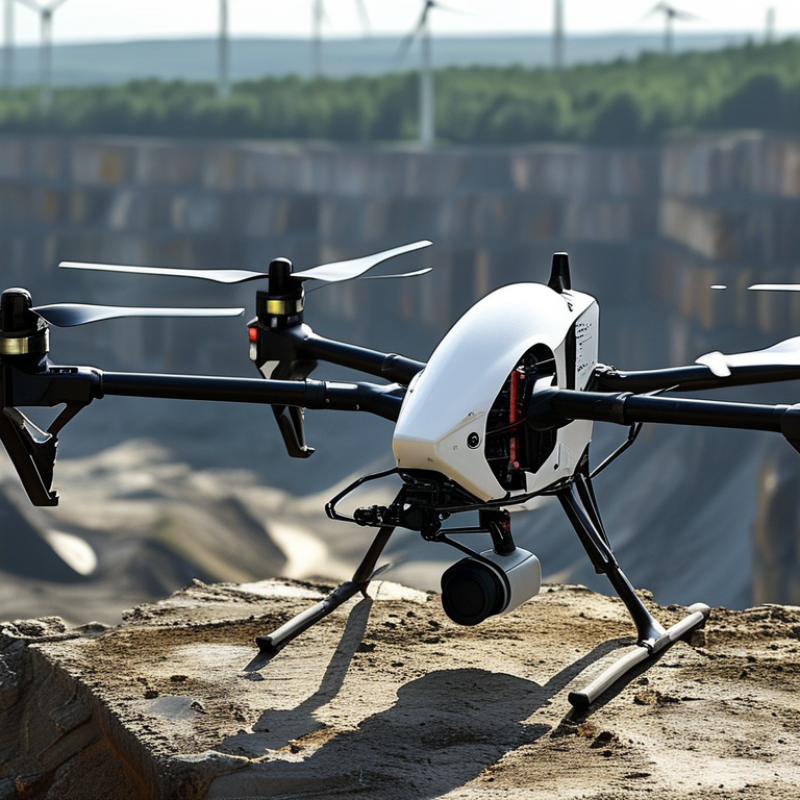
An industrial quadcopter in 2026 is more than a larger recreational drone. It is a work system built for repeatable results, harsh conditions, and accountable data. Its value comes from reliable flight, useful payloads, secure communication, and practical maintenance.
A serious platform should carry cameras, thermal sensors, or inspection equipment without losing stability. It should maintain accurate positioning near structures, dust, wind, and changing temperatures. Redundant power and navigation systems can reduce single-point failures. However, redundancy does not remove risk. Operators still need documented procedures, equipment checks, and training that reflects real field conditions.
Industrial performance also depends on the software behind the aircraft. Edge processing can identify cracks, heat changes, or crop stress during a mission. Encrypted data links and controlled access help protect inspection records. Detailed flight logs support maintenance and independent review. Battery health tracking matters more than impressive laboratory endurance. A shorter, predictable mission may be safer than a long advertised flight.
From practical testing, I would judge a quadcopter by completed tasks, not specifications alone. Can one technician prepare it beside a wind turbine? Can the system recover useful data after weak connectivity? Can worn parts be replaced without extended downtime? These questions expose weaknesses quickly. No platform is perfect. A reliable choice accepts those limits and documents them clearly. Local aviation requirements, site rules, and privacy obligations must also shape the final selection.
How to Choose an Industrial Quadcopter in 2026? - What Defines an Industrial Quadcopter in 2026?
A practical comparison framework using representative planning ranges for industrial quadcopter selection
| Selection Dimension | Inspection and Mapping Class | Professional Multi-Sensor Class | Heavy-Payload Utility Class |
|---|---|---|---|
| Primary Industrial Use | Roof, façade, bridge, construction, and land surveys | Power-line, pipeline, infrastructure, public-safety, and thermal inspection | Material delivery, emergency logistics, spraying, lifting, and specialized industrial operations |
| Typical Maximum Takeoff Mass | Up to approximately 7 kg | Approximately 7–25 kg | Approximately 25–50 kg or more, subject to local aviation rules |
| Useful Payload Capacity | Approximately 0.3–2 kg | Approximately 1–5 kg | Approximately 5–15 kg |
| Practical Flight Time | Approximately 25–45 minutes without a heavy payload | Approximately 25–50 minutes, depending on sensors, weather, and battery configuration | Approximately 15–35 minutes under high payload; substantially longer only with specialized energy systems |
| Operational Wind Capability | Typically about 10–12 m/s | Typically about 12–15 m/s | Typically about 10–14 m/s because payload increases aerodynamic and control demands |
| Weather and Ingress Protection | Prefer an enclosure rated at least IP43 for light rain and dust exposure | IP54 or higher is preferred for recurring outdoor industrial work | Prefer IP54 or higher, with additional protection for motors, payload interfaces, and batteries |
| Positioning Accuracy | Standard satellite positioning for general inspection; RTK or PPK for accurate mapping | RTK/PPK with centimeter-level relative positioning for repeatable inspection and surveying | High-integrity positioning with redundancy is more important than centimeter-level mapping accuracy |
| Imaging Payloads | High-resolution visible camera; optional 3-axis stabilized gimbal | Visible, thermal, zoom, multispectral, or LiDAR payload combinations | Mission payload is prioritized; imaging is usually secondary to lifting or delivery performance |
| Thermal Inspection Capability | Optional thermal camera for basic hotspot detection | Radiometric thermal imaging with temperature measurement and calibrated reporting | Optional, provided that sensor weight and power consumption do not compromise lift capacity |
| Obstacle Detection | Forward and downward sensing is generally sufficient for controlled sites | Omnidirectional sensing, terrain awareness, and low-light assistance are recommended | Redundant obstacle detection and conservative flight logic are essential near structures and people |
| Autonomous Flight Functions | Waypoint missions, orbit flights, grid mapping, and return-to-home | Waypoint automation, terrain following, corridor inspection, repeatable routes, and automated data capture | Route automation, payload release controls, geofencing, contingency routing, and remote supervision |
| Data and Connectivity | Encrypted controller link with local media storage | Encrypted command link, dual-frequency positioning, cloud or local workflow integration, and audit logs | Redundant communications, health telemetry, remote identification, and reliable operation beyond direct visual monitoring where legally permitted |
| Communication Range | Approximately 2–8 km in unobstructed conditions; actual legal limits may be lower | Approximately 5–15 km in unobstructed conditions, subject to radio regulations and operating environment | Approximately 5–15 km with redundant links preferred for high-consequence missions |
| Battery and Power System | Smart battery with cell monitoring, temperature protection, and rapid field replacement | Hot-swappable batteries, battery health analytics, charging logistics, and optional dual-battery redundancy | High-current battery system, redundant power monitoring, fire-safe transport, and dedicated charging infrastructure |
| Safety and Redundancy | Return-to-home, low-battery landing, geofencing, and propeller or motor monitoring | Redundant positioning, obstacle sensing, flight-control monitoring, and documented emergency procedures | Redundant propulsion, power, communications, and fail-safe payload operation should be treated as core requirements |
| Regulatory Readiness | Confirm registration, pilot competency, operating area, and visual-line-of-sight requirements | Confirm aircraft category, remote identification, operational risk assessment, night-flight rules, and any beyond-visual-line-of-sight approval | Confirm maximum takeoff mass, airspace authorization, dangerous-goods or cargo rules, crew requirements, and operational approval |
| Data Security | Encrypted storage and controlled access are recommended | Encryption in transit and at rest, role-based access, secure firmware updates, and retention controls | Mission-critical cybersecurity, authenticated commands, tamper-resistant logs, and strict payload-control permissions |
| Best Choice When | Low operating cost, portability, and accurate visual documentation are the main priorities | One aircraft must support several sensors, repeatable workflows, and professional inspection reporting | Payload capacity, reliability, and operational resilience are more important than compact size or maximum flight time |
Note: The figures above are representative engineering and procurement ranges rather than universal specifications. Actual performance depends on aircraft configuration, payload mass, battery condition, temperature, altitude, wind, terrain, communication environment, and applicable aviation regulations.