
Quality Products

At a Fair Price

Wholesale Provider

Of Valves & Fittings

  • Corporate Office: 1301 Greengrass Drive Houston, TX 77008
  • 1-800-237-2512

Quality Products

At a Fair Price

Wholesale Provider

Of Valves & Fittings

How to Choose a Dancing Water Fountain for Your Project?

Choosing the right Dancing Water Fountain begins with understanding your project, not copying a design from another site. A fountain that looks impressive in a hotel lobby may fail in a public plaza. Space, visitor flow, climate, water quality, and maintenance access all influence the final choice. Careful planning protects both the visual effect and the long-term budget.

Start with the experience you want to create. Do you need gentle water movements for a quiet garden, or powerful jets with synchronized lighting for an entertainment venue? Measure the installation area, viewing distances, pool depth, and equipment room before speaking with suppliers. A professional manufacturer should explain pump capacity, nozzle performance, control systems, safety features, and expected energy use. Ask for technical drawings and maintenance recommendations. Do not rely only on attractive videos.

Details matter.

A reliable Dancing Water Fountain should use corrosion-resistant materials, properly selected pumps, and controls that suit local operating conditions. Weather, hard water, wind, and seasonal temperature changes can affect performance. I have seen projects underestimate cleaning access and later struggle with blocked nozzles or uneven water patterns. That mistake is avoidable, although every site has unknown factors. Testing samples, checking supplier experience, and reviewing completed installations can improve your decision. The best fountain is not always the largest or most complex. It is the system that delivers a memorable effect, manageable operation, and dependable performance for many years.
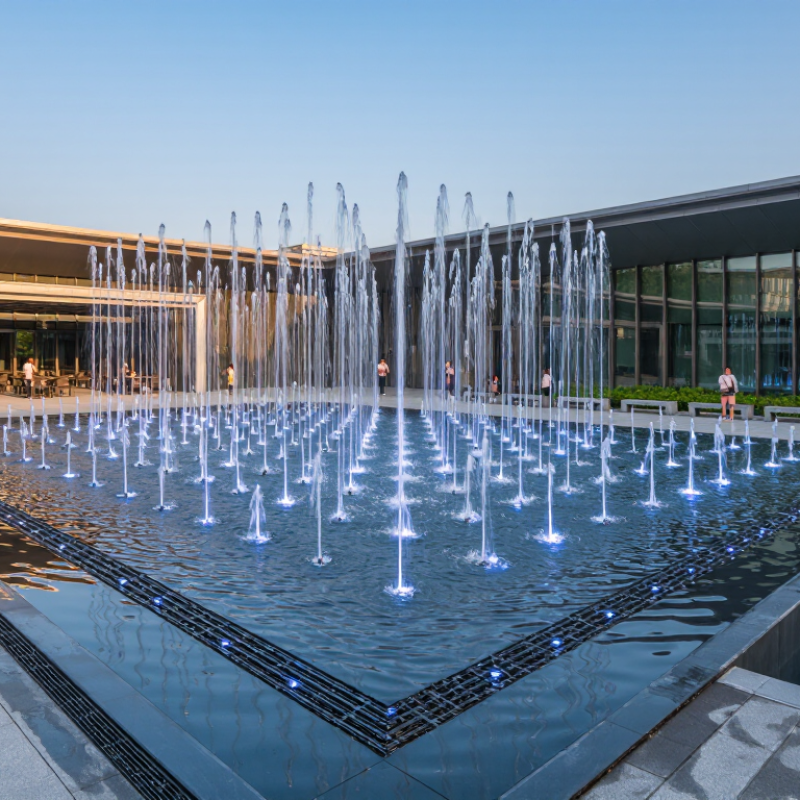
How to Choose a Dancing Water Fountain for Your Project?

Define Show Scale: 0.5–5 m Jets, 30–120° Angles, and Viewing Distance

How to Choose a Dancing Water Fountain for Your Project?

A dancing water fountain should be selected by show scale, not catalog height alone. Start with the jet range: 0.5 to 5 meters. A half-meter jet suits intimate courtyards, hotel entrances, and low viewing positions. A five-meter jet needs more space, stronger wind assessment, and careful structural coordination.

The difference is dramatic. Measure viewing distance from likely standing areas, not the property boundary. At eight meters, a three-meter jet can feel balanced. At twenty-five meters, it may look visually weak.

The difference is dramatic.

Jet angles also shape the audience experience. A 30-degree angle creates a narrow, upright rhythm with clear vertical movement. Wider angles, from 90 to 120 degrees, produce broader fans and stronger side-to-side coverage. However, wide sprays can overlap awkwardly when nozzles are placed too closely. Leave room for water movement, maintenance access, and changing wind conditions. Small errors become obvious under lighting.

I once focused too heavily on maximum jet height and underestimated the viewing distance.

In project planning, draw the fountain at full scale before selecting pumps or controls. Mark the nearest and farthest viewing points. Check whether trees, benches, or railings interrupt the main sightline.

That assumption was wrong. The display looked impressive on paper but lacked presence from the public walkway. A practical mock-up, even with temporary markers, can reveal this early. Record wind direction at different times, because a calm morning does not represent every operating period.

Calculate Pump Duty from Flow, Head, and 60–80% System Efficiency

Choosing a dancing water fountain begins with a realistic pump duty calculation. Estimate the required flow rate from nozzle size, spray height, and the number of active nozzles. Then calculate total head, including elevation, pipe friction, fittings, filters, and nozzle pressure requirements. A beautiful spray can fail when hidden losses are ignored.

Use this basic formula: hydraulic power equals ρ × g × Q × H. Here, Q is flow in cubic metres per second, and H is total head in metres. Divide the hydraulic power by an expected system efficiency of 60–80 percent. This gives a practical estimate of electrical input power. For example, 0.02 m³/s at 12 metres requires about 2.35 kilowatts hydraulically. At 70 percent efficiency, the input demand approaches 3.36 kilowatts. Leave sensible capacity for dirty filters and changing water levels.

Tips: Measure pipe lengths on the actual layout, not only from drawings. Check the pump curve at the selected duty point. Ask for stable operation near that point. I have sometimes underestimated small fittings. Their combined loss can noticeably reduce spray height. Test one nozzle pattern before finalizing every outlet. Record pressure, flow, and motor current during commissioning. These details reveal problems that calculations may miss. Keep a small reserve, but avoid oversizing, because excessive flow can create splash, noise, and unstable choreography.

How to Choose a Dancing Water Fountain for Your Project? - Calculate Pump Duty from Flow, Head, and 60–80% System Efficiency

Project Scenario Typical Fountain Application Design Flow
(m³/h)
Total Dynamic Head
(m)
Estimated Hydraulic Power
(kW)
Design System Efficiency Estimated Pump Input Power
(kW)
Suggested Motor Rating
(kW)
Small decorative feature Short vertical jets or a compact bubbling display 30 8 0.65 65% 1.01 1.5
Medium plaza fountain Multiple adjustable jets with moderate spray height 50 10 1.36 70% 1.95 2.2–3.0
Interactive water feature Several synchronized jets with frequent flow changes 80 12 2.62 75% 3.49 4.0
Large choreographed fountain High-flow nozzles with lighting and programmed sequences 120 15 4.91 65% 7.55 9.2–11.0
Public landmark fountain Large-scale display with multiple zones and long pipe runs 200 18 9.81 70% 14.01 15.0–18.5
High-output performance fountain Large synchronized jets requiring substantial peak flow 300 22 17.99 60% 29.98 37.0

Calculation method: Hydraulic power = ρ × g × Q × H, where ρ is water density at approximately 1,000 kg/m³, g is gravitational acceleration at 9.81 m/s², Q is flow in m³/s, and H is total dynamic head in metres.

Pump input power: Pump input power = Hydraulic power ÷ System efficiency. A practical fountain system efficiency range is approximately 60–80%, including pump, motor, pipework, valves, filters, and fittings.

Total dynamic head: Include the vertical lift, nozzle pressure requirement, pipe friction, fittings, valves, filters, and other hydraulic losses. Do not select a pump using static height alone.

Motor selection: The suggested motor rating provides a practical allowance above the calculated input power. Final selection should be confirmed using the pump curve at the required flow and head, operating schedule, water quality, control method, and local electrical requirements.

Choose Nozzles by 10–50 mm Orifice Size and ±1 mm Alignment Tolerance

How to Choose a Dancing Water Fountain for Your Project?

Choosing a dancing water fountain starts with the nozzle, not the lighting schedule. Orifice size directly affects jet height, flow rate, and pump demand. A 10 mm opening can create a fine, responsive stream for smaller basins. A 50 mm opening produces a heavier jet with greater visual presence. That difference matters. Use measured flow data, not attractive catalog images, when selecting equipment. Consider wind, water depth, viewing distance, and the required movement speed. A narrow jet may look elegant indoors but lose shape outdoors.

Alignment deserves equal attention. Keep each nozzle within a ±1 mm alignment tolerance whenever possible. Small errors can make symmetrical patterns appear uneven, especially during slow movements. During installation, I recommend using a rigid template and checking every nozzle from two directions. Measure from the basin centerline, then verify the angle after pipe connections are tightened. Do not trust hand positioning alone. It often shifts later.

Pump selection should match the combined nozzle demand, pipe friction, and control sequence. Leave practical adjustment capacity rather than operating continuously at maximum output. I have seen projects focus heavily on jet height and overlook maintenance access. That is an expensive mistake. Provide removable strainers, clear inspection points, and enough space for calibration. Test the fountain with clean water before programming choreography. A perfect drawing can still produce an imperfect show. Real commissioning usually reveals something worth correcting.

Specify DMX512 Control, 25–50 ms Cue Timing, and IP65 Enclosures

How to Choose a Dancing Water Fountain for Your Project?

A dancing water fountain should be selected around its control system, timing, and installation environment. Specify DMX512 control when your project needs coordinated pumps, lights, and valves. Confirm channel capacity, addressing methods, signal termination, and controller compatibility before ordering. Small timing errors can make water movements appear late.

For musical shows, require 25–50 ms cue timing as a practical performance target. Ask the supplier to explain how timing is measured, not only how it is advertised.

Test several cues with real pumps and lighting fixtures. A 30 ms response may look smooth in a short sequence, but repeated commands can reveal instability.

I once trusted a paper specification too quickly. The field test showed noticeable delays.

Tips: Choose IP65 enclosures for outdoor areas exposed to dust and water jets. IP65 does not mean underwater protection. Check cable glands, drainage, ventilation, and access for maintenance. Leave space around the control cabinet. Wet hands and crowded wiring create avoidable problems. Ask for test records, wiring diagrams, and a sample cue file. Also inspect the fountain during wind and bright daylight, because visual timing may seem different from indoor demonstrations. A technically correct system can still need adjustment.

Verify Water Safety, ≤30 mA RCD Protection, and NFPA 70 Compliance

How to Choose a Dancing Water Fountain for Your Project?

A dancing water fountain needs more than attractive jets and programmable lights. Begin with water safety. Confirm the basin design prevents public contact with hazardous electrical parts. Use suitable filtration, disinfection, and chemical monitoring for the intended use. Decorative water is not automatically safe for drinking or skin contact. Check slip resistance around the wet deck, especially near entrances and children’s areas. Small details matter.

Electrical protection deserves careful verification. Specify residual-current protection rated at no more than 30 mA, where required by the project’s electrical design and local regulations. An RCD is not a substitute for correct grounding, bonding, insulation, or enclosure ratings. Ask a qualified electrician to test trip time, leakage current, and protective conductor continuity. Keep test records. They may reveal problems before installation is complete.

NFPA 70 compliance should be reviewed during design, not after equipment arrives. Check wiring methods, disconnects, grounding, wet-location equipment, controls, and accessible maintenance areas. The current adopted edition and local amendments must guide the review. A drawing can look compliant while a field connection remains exposed to spray. I have learned that assumptions fail around water. Require documented commissioning, lockable isolation, and clear inspection intervals. Do not hide the panel. Make it reachable, labeled, and dry.

Top
error: Content is protected !!