
Quality Products
At a Fair Price
Wholesale Provider
Of Valves & Fittings
- HOME
- Products
- Ball Valves
- Bull Plugs & Swages
- Butterfly Valves
- Check Valves
- Cushion / Flow Tees & Bleed Rings
- Enhanced Oil Recovery
- Floating Ball Valves
- Foot Valves
- Forged Steel Fittings
- Forged Steel Outlets
- Gaskets-Insulation Kits
- Gate Valves
- Gate, Globe & Check Valves
- Malleable Fittings
- Needle Valves
- Nipples
- Piston Valves
- Plug Valves
- Stainless Steel Flanges, Fittings & Nipples
- Strainers
- Studs
- Trunnion
- Unions
- Weld Fittings & Flanges
- Manufacturers
- Advance
- American Block
- Anvil
- Balon
- Bonney Forge
- Champion
- Clayton Mark
- Crane
- Daniel
- DMIC
- GMI
- Galli & Cassina
- Hackney-Ladish
- JMC
- Lone Star
- MATCO
- Marpac-McCanna
- National Flange
- National Gasket
- Nordstrom
- Nutron
- PPI
- SHARPE
- SMI
- TEXSTEAM
- TEX-THREAD
- Titan
- USA Fastner
- Vogt
- Weld Bend
- Westbrook
- Wheatley
- Williams
- WKM
- Wolar
- Locations
- Contact
- Blog
- Careers
- Get a Quote
- HOME
- Products
- Ball Valves
- Bull Plugs & Swages
- Butterfly Valves
- Check Valves
- Cushion / Flow Tees & Bleed Rings
- Enhanced Oil Recovery
- Floating Ball Valves
- Foot Valves
- Forged Steel Fittings
- Forged Steel Outlets
- Gaskets-Insulation Kits
- Gate Valves
- Gate, Globe & Check Valves
- Malleable Fittings
- Needle Valves
- Nipples
- Piston Valves
- Plug Valves
- Stainless Steel Flanges, Fittings & Nipples
- Strainers
- Studs
- Trunnion
- Unions
- Weld Fittings & Flanges
- Manufacturers
- Advance
- American Block
- Anvil
- Balon
- Bonney Forge
- Champion
- Clayton Mark
- Crane
- Daniel
- DMIC
- GMI
- Galli & Cassina
- Hackney-Ladish
- JMC
- Lone Star
- MATCO
- Marpac-McCanna
- National Flange
- National Gasket
- Nordstrom
- Nutron
- PPI
- SHARPE
- SMI
- TEXSTEAM
- TEX-THREAD
- Titan
- USA Fastner
- Vogt
- Weld Bend
- Westbrook
- Wheatley
- Williams
- WKM
- Wolar
- Locations
- Contact
- About
- Careers
- Get a Quote
China Top High Alumina Castable Manufacturer?
Choosing a China Top High Alumina Castable Manufacturer requires more than comparing alumina percentages or factory prices. The real question is performance under heat, abrasion, chemical attack, and repeated shutdowns. High Alumina Castable is used in steel ladles, cement kilns, reheating furnaces, and other severe-duty linings. Each application demands a different balance of aggregate grading, calcium aluminate cement, additives, installation method, and curing control.
Industry demand remains substantial. The World Steel Association reported 1,882.6 million tonnes of global crude steel production in 2024. The International Energy Agency has also identified cement as a major industrial sector, with global cement production near 4.1 billion tonnes annually. These figures indicate sustained demand for reliable refractory materials. They do not prove that every Chinese supplier delivers equal quality. That distinction matters.
Professor W. E. Lee, a respected refractories researcher, stated, “Refractory performance depends on both material design and correct application.” It is a simple warning. A laboratory result can fail in a wet kiln shell or a poorly cured furnace floor. Buyers should request chemical analysis, bulk density, porosity, permanent linear change, cold crushing strength, and abrasion data. ASTM C133 and ASTM C704 can support meaningful comparisons.
A credible manufacturer should explain its raw-material sources, mixing uniformity, batch traceability, and installation guidance. Site experience matters. So does honest limitation. Some products appear impressive on paper, yet crack after thermal cycling. A stronger evaluation combines test reports, operating references, technical audits, and controlled field trials before final selection.
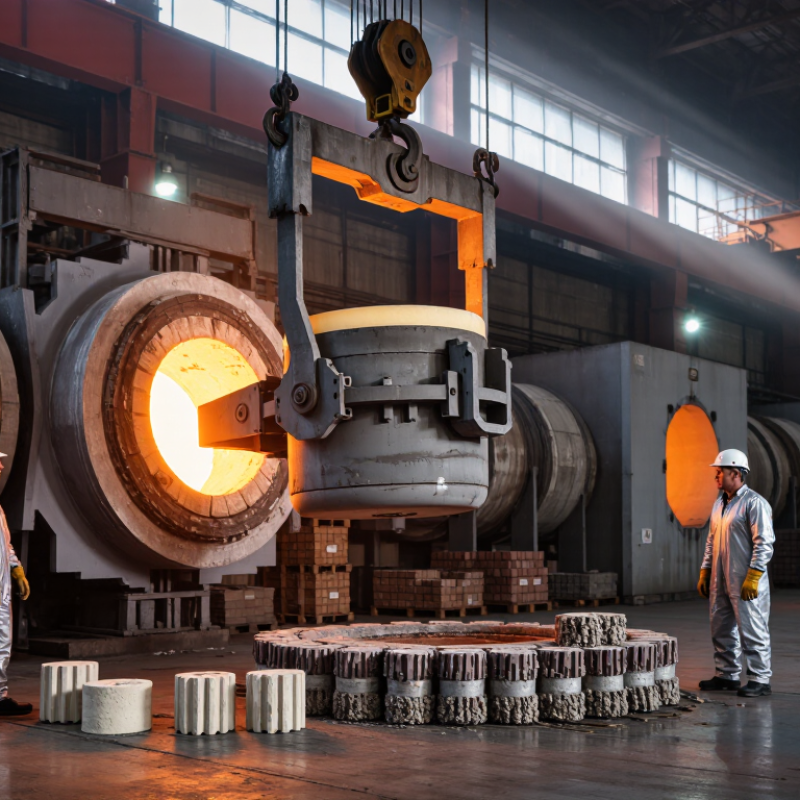
What Is High Alumina Castable?
High alumina castable is a monolithic refractory concrete with a high proportion of alumina-rich aggregates and binder. It is designed for areas exposed to heat, abrasion, chemical attack, or sudden temperature changes. Unlike shaped firebrick, it arrives as a dry mix and forms directly inside a furnace lining. Its performance depends on chemistry, installation, and service conditions. That last point matters.
In practical work, technicians blend the powder with measured water, place it around anchors, and compact it carefully. Too much water creates pores and weakens the fired structure. Too little water leaves dry pockets. After placement, controlled curing helps the binder develop strength. The lining then needs a gradual dry-out schedule, because trapped moisture can cause cracking or explosive spalling. This stage is often underestimated.
Alumina content alone does not define quality. Aggregate grading, cement type, additives, bulk density, and thermal expansion also affect results. A reliable selection begins with operating temperature, load, atmosphere, abrasion level, and repair method. Laboratory data should be checked against actual site practice, not accepted blindly. I have seen a technically strong mix fail after rushed installation. That is a useful warning. High alumina castable is powerful, but it is not universal.
What Is High Alumina Castable?
High alumina castable is a monolithic refractory concrete containing a high proportion of alumina (Al₂O₃). As alumina content increases, the material generally offers better resistance to heat, slag, abrasion, and chemical attack.
The chart shows representative alumina content levels and typical continuous service-temperature ranges used for high alumina castable classifications. Actual performance depends on raw materials, installation, curing, dry-out, atmosphere, and operating conditions.
Key Properties and Industrial Applications
China Top High Alumina Castable Manufacturer?
High alumina castable contains a high percentage of alumina aggregates and fine powders. Its mineral structure supports strong heat resistance, abrasion resistance, and chemical stability. Many grades use calcium aluminate cement as a bonding system. Performance depends on alumina content, aggregate grading, apparent porosity, and installation quality. It is not universal.
In steel ladles, furnace bottoms, and burner zones, this refractory withstands molten metal contact and repeated thermal cycling. Cement kilns, heat-treatment furnaces, and waste-incineration units also use it near intense flames. A dense grade can resist erosion from moving materials. A low-cement grade may provide lower porosity and better corrosion resistance. However, higher alumina does not automatically guarantee longer service. Thermal shock, joint design, and drying conditions can change the result.
Tips: Select the grade according to temperature, slag chemistry, abrasion, and operating cycles. During installation, measure mixing water carefully and avoid over-vibration. Dry the lining gradually, because trapped moisture can create internal pressure. Small gaps matter. Record curing time, heating rates, and repair areas for future evaluation. Field feedback should guide the next material selection, even when laboratory results look excellent.
China Top High Alumina Castable Manufacturer? - Key Properties and Industrial Applications
| Data Dimension | Typical Information | Industrial Significance |
|---|---|---|
| Material Definition | A monolithic refractory concrete containing a high proportion of alumina-bearing aggregates and a hydraulic or chemically bonded matrix. | Provides joint-free lining construction and can be installed in complex furnace shapes. |
| Alumina Content (Al2O3) | Common commercial grades contain approximately 50–90% Al2O3; specialized grades may exceed 90%. | Higher alumina generally improves refractoriness, chemical stability, and resistance to slag attack. |
| Maximum Service Temperature | Typically about 1,500–1,800 °C, depending on composition, bonding system, installation quality, and operating atmosphere. | Suitable for high-temperature zones in furnaces, kilns, heaters, and reactors. |
| Bulk Density | Usually approximately 2.2–3.0 g/cm3, with dense grades at the higher end of the range. | Higher density normally supports improved wear resistance and lower apparent porosity. |
| Apparent Porosity | Common dense castable grades are often within approximately 15–25% after proper curing and firing. | Lower porosity can reduce penetration by molten slag, metal, and corrosive process liquids. |
| Cold Crushing Strength | Typical values may range from approximately 40–100 MPa after drying or firing, depending on grade and test temperature. | Indicates resistance to handling, impact, abrasion, and mechanical loading at ambient conditions. |
| Permanent Linear Change | Often controlled within approximately ±0.5% after firing at a specified temperature, although the actual value depends on formulation. | Dimensional stability helps minimize gaps, cracking, and stress concentration during thermal cycling. |
| Thermal Shock Resistance | Generally good when the aggregate grading, matrix design, installation, and dry-out schedule are properly matched to service conditions. | Helps the lining withstand repeated heating and cooling, start-ups, shutdowns, and fluctuating process loads. |
| Abrasion Resistance | High in dense, well-graded formulations, particularly those using hard alumina aggregates and a low-cement or ultra-low-cement matrix. | Important for areas exposed to moving ore, clinker, ash, coke, pellets, dust, or high-velocity gases. |
| Chemical Resistance | Strong resistance to many acidic and neutral slags; compatibility must still be checked against basic slags, alkalis, fluorides, and process-specific chemicals. | Correct chemistry selection extends lining life and reduces penetration, spalling, and dissolution. |
| Thermal Conductivity | Dense high-alumina castables commonly show approximately 1.5–3.0 W/(m·K) near room temperature, depending on density and temperature. | Affects shell temperature, heat loss, thermal gradients, and the required thickness of the refractory lining. |
| Installation Methods | Common methods include casting, vibration casting, pumping, shotcreting, and hand placement, depending on the product design. | Installation flexibility supports repairs, complicated geometries, large monolithic linings, and reduced joint exposure. |
| Curing and Dry-Out | Requires controlled mixing water, adequate curing, gradual drying, and a staged heat-up schedule to release physically and chemically bound moisture. | Proper dry-out reduces the risk of steam spalling, explosive damage, cracking, and premature lining failure. |
| Iron and Steel Industry | Used in ladle linings, runners, tundish areas, soaking furnaces, reheating furnaces, and high-wear impact zones. | Combines high-temperature capability with resistance to molten metal, slag, erosion, and thermal cycling. |
| Cement and Lime Industry | Applied in preheaters, tertiary air ducts, kiln hoods, coolers, burner areas, and other zones exposed to heat and abrasion. | Supports resistance to clinker dust, mechanical wear, thermal cycling, and process gas exposure. |
| Non-Ferrous Metallurgy | Used in copper, aluminum, nickel, and other non-ferrous melting and heat-treatment equipment where alumina compatibility is appropriate. | Provides protection against heat, molten materials, erosion, and selected chemical attack. |
| Petrochemical and Chemical Processing | Used in selected furnace linings, reformer components, incinerators, reactors, transfer lines, and abrasion-prone areas. | Offers protection from high temperature, particle erosion, and process chemicals when the formulation is properly matched. |
| Waste-to-Energy and Incineration | Applied in combustion chambers, furnace walls, afterburners, ash zones, and areas exposed to corrosive flue gases. | Helps resist abrasion, thermal cycling, ash deposition, and selected alkali or chloride-related attack. |
| Selection Criteria | Evaluate alumina level, aggregate type, cement content, density, porosity, strength, abrasion loss, thermal shock, chemical exposure, and installation method. | A specification based on actual operating conditions is more reliable than selecting a castable by alumina percentage alone. |
Note: The numerical values are typical reference ranges for dense high-alumina castables. Actual properties vary with raw materials, particle grading, bonding system, mixing procedure, curing, firing temperature, and test standards.
How China’s Top Manufacturers Produce High Alumina Castables
China’s top high alumina castable manufacturers begin with controlled raw materials, not mixing equipment. The 2024 USGS Mineral Commodity Summaries estimated global alumina production at about 142 million metric tons in 2023. This scale supports a broad supply of alumina-based aggregates, but quality still depends on grading and impurity control.
Manufacturers usually combine tabular alumina, fused alumina, reactive alumina, calcium aluminate cement, and carefully selected additives. Each batch is weighed by automated systems. Particle grading is checked before dry mixing. The target is dense packing with minimal open pores. Water is added gradually, often below six percent for low-cement formulations. Too much water improves placement, but weakens strength after drying.
Technicians then test flow, bulk density, cold crushing strength, permanent linear change, and thermal shock resistance. These checks follow methods described in standards such as ASTM C401 and related refractory testing procedures. The World Steel Association reported approximately 1.89 billion tonnes of crude steel production in 2023. That figure explains the demand for castables used around furnaces, runners, and ladles.
Curing normally occurs under controlled temperature and humidity. Dry-out follows slowly, because trapped steam can damage the lining. Experienced producers also inspect installation records and furnace operating conditions. A laboratory result cannot fully predict field performance. This is where manufacturing can remain imperfect. Slight moisture variation, rushed curing, or poor vibration may reduce service life, even when the recipe appears correct.
Quality Standards and Performance Evaluation
China Top High Alumina Castable Manufacturer?
Quality Standards and Performance Evaluation
A reliable high alumina castable begins with controlled raw materials, not impressive sales claims. Alumina content, impurity levels, grain size, and moisture should be checked for every production batch. Clear batch records help connect laboratory results with actual delivery conditions. Test it hot.
Performance evaluation should cover more than cold crushing strength. Inspectors should measure permanent linear change, abrasion resistance, thermal shock behavior, and corrosion resistance. Setting time and flow also matter during installation. Excess mixing water may reduce strength and create hidden pores. Small details matter.
In practical inspections, a castable can pass a laboratory test yet crack inside a furnace. This happens when curing, drying, or heating differs from the test procedure. A dependable manufacturer should provide technical data, sampling records, and traceable test reports. Site feedback deserves equal attention. Numbers need context.
Quality checks should follow recognized national or international methods, with consistent sample preparation and calibrated equipment. Factory audits can examine storage conditions, mixer cleanliness, weighing accuracy, and worker training. These points are less visible, but they strongly influence performance. No evaluation is perfect. Teams should review failed sections honestly and adjust material selection, installation practice, or heating schedules.
How to Choose a Reliable Chinese Manufacturer
China Top High Alumina Castable Manufacturer?
Choosing a reliable Chinese manufacturer requires more than comparing prices. Check its production experience, laboratory equipment, and quality control records. An experienced supplier should explain alumina content, calcium aluminate cement, particle grading, bulk density, and working temperature clearly. Ask for recent test reports, not only standard templates. Confirm whether each batch receives testing before shipment.
Request a small sample before placing a large order. Apply it to a trial panel or a similar repair area, then inspect flow, setting time, strength, and surface cracking. Reliable manufacturers can provide technical data, installation guidance, storage instructions, and traceable batch numbers. Factory videos help, but an independent audit gives stronger evidence. I have seen attractive specifications fail during mixing because the water range was unclear. That detail matters. No supplier is flawless, so judge how openly the team handles defects and corrective actions.
Tips: Compare three quotations carefully. Check the actual alumina percentage. Ask for ISO or equivalent quality records. Confirm packaging against moisture damage. Review delivery history and replacement procedures. Test before scaling up. A rushed decision can create expensive downtime.
