Quality Products
At a Fair Price
Wholesale Provider
Of Valves & Fittings
- HOME
- Products
- Ball Valves
- Bull Plugs & Swages
- Butterfly Valves
- Check Valves
- Cushion / Flow Tees & Bleed Rings
- Enhanced Oil Recovery
- Floating Ball Valves
- Foot Valves
- Forged Steel Fittings
- Forged Steel Outlets
- Gaskets-Insulation Kits
- Gate Valves
- Gate, Globe & Check Valves
- Malleable Fittings
- Needle Valves
- Nipples
- Piston Valves
- Plug Valves
- Stainless Steel Flanges, Fittings & Nipples
- Strainers
- Studs
- Trunnion
- Unions
- Weld Fittings & Flanges
- Manufacturers
- Advance
- American Block
- Anvil
- Balon
- Bonney Forge
- Champion
- Clayton Mark
- Crane
- Daniel
- DMIC
- GMI
- Galli & Cassina
- Hackney-Ladish
- JMC
- Lone Star
- MATCO
- Marpac-McCanna
- National Flange
- National Gasket
- Nordstrom
- Nutron
- PPI
- SHARPE
- SMI
- TEXSTEAM
- TEX-THREAD
- Titan
- USA Fastner
- Vogt
- Weld Bend
- Westbrook
- Wheatley
- Williams
- WKM
- Wolar
- Locations
- Contact
- Blog
- Careers
- Get a Quote
- HOME
- Products
- Ball Valves
- Bull Plugs & Swages
- Butterfly Valves
- Check Valves
- Cushion / Flow Tees & Bleed Rings
- Enhanced Oil Recovery
- Floating Ball Valves
- Foot Valves
- Forged Steel Fittings
- Forged Steel Outlets
- Gaskets-Insulation Kits
- Gate Valves
- Gate, Globe & Check Valves
- Malleable Fittings
- Needle Valves
- Nipples
- Piston Valves
- Plug Valves
- Stainless Steel Flanges, Fittings & Nipples
- Strainers
- Studs
- Trunnion
- Unions
- Weld Fittings & Flanges
- Manufacturers
- Advance
- American Block
- Anvil
- Balon
- Bonney Forge
- Champion
- Clayton Mark
- Crane
- Daniel
- DMIC
- GMI
- Galli & Cassina
- Hackney-Ladish
- JMC
- Lone Star
- MATCO
- Marpac-McCanna
- National Flange
- National Gasket
- Nordstrom
- Nutron
- PPI
- SHARPE
- SMI
- TEXSTEAM
- TEX-THREAD
- Titan
- USA Fastner
- Vogt
- Weld Bend
- Westbrook
- Wheatley
- Williams
- WKM
- Wolar
- Locations
- Contact
- About
- Careers
- Get a Quote
China Best Rubber Dam for River Water Level Control?
Choosing the China Best Rubber Dam for River Water Level Control requires more than comparing prices, photographs, or advertised discharge figures. A reliable selection must match river width, flood frequency, sediment movement, foundation conditions, and operating objectives. During field inspections, engineers should examine the rubber membrane, anchor bolts, control valves, embedded steelwork, and upstream debris. Small defects can become serious during sudden floods.
The need for adaptable river infrastructure is increasing. The World Meteorological Organization’s State of Global Water Resources 2023 reported abnormal river flows across many regions, reflecting stronger hydrological variability. The United Nations World Water Development Report 2024 also highlighted growing pressure on freshwater systems. These findings support adjustable structures, but they do not prove that every Rubber Dam For River Water Level Control project is suitable. Site evidence remains essential. Sometimes, the cheapest option becomes the most expensive mistake.
Water-resources expert Dr. Asit K. Biswas stated, “There is no water crisis in the world. There is a crisis of governance.” This observation matters for rubber dam planning. Good governance means transparent testing, documented maintenance, emergency procedures, and independent technical review. The International Commission on Large Dams also emphasizes risk-based assessment and lifecycle safety for hydraulic structures. China has strong manufacturing capacity, but “made in China” alone does not establish quality. Buyers should request material certificates, factory inspection records, design calculations, and operating references from comparable rivers. A rubber dam can raise a calm water surface beautifully. It can also fail quietly when maintenance is ignored. The final choice should balance hydraulic performance, service support, durability, and verified field experience.
Rubber Dams: Structure and Role in River Water Level Control
China Best Rubber Dam for River Water Level Control?
Rubber Dams: Structure and Role in River Water Level Control
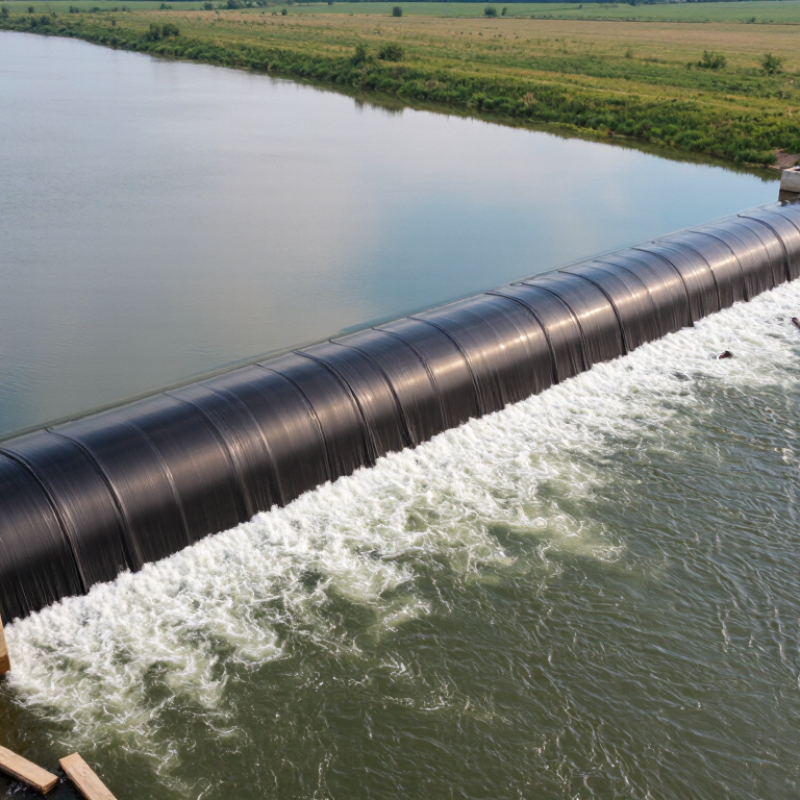
A rubber dam uses a reinforced elastomer membrane fixed to a concrete foundation. Water or air fills the membrane, raising it across the river channel. When operators release the filling medium, the dam folds down and restores flow. Steel anchors, side seals, pipes, valves, and control equipment support this movement.
The structure looks simple, but reliable control requires careful engineering. Sensors can track upstream level, downstream discharge, membrane pressure, and rainfall. During normal operation, the dam may maintain water for irrigation, municipal intake, navigation, or habitat support. During heavy rainfall, rapid deflation creates more space for passing floodwater. Small changes matter.
Field inspections often find damage near anchor edges and floating debris. Sharp branches can scrape the membrane. Sediment may also reduce the effective channel width. Regular checks should examine pressure records, leakage, valve response, concrete joints, and emergency power. Local climate matters too. Freezing conditions, strong ultraviolet exposure, and sudden water-level changes can shorten service life. No rubber dam is perfect. A design that works well on a narrow, clean channel may perform poorly in a wide river with heavy sediment. Site surveys, hydraulic modelling, and conservative operating rules remain necessary before selecting a system.
Key Factors for Selecting China’s Best Rubber Dam
China Best Rubber Dam for River Water Level Control?
Key Factors for Selecting China’s Best Rubber Dam
Selecting a rubber dam in China requires more than comparing prices and photographs. The river’s flow, sediment load, flood frequency, and foundation condition should guide the design. A reliable supplier must provide hydraulic calculations, material test reports, and clear installation drawings. Site evidence matters.
During field inspections, I check the anchoring system first. Weak anchors can cause leakage, movement, or sudden deflation. The rubber membrane should resist ultraviolet exposure, abrasion, temperature changes, and repeated inflation cycles. Reinforced layers need consistent thickness, not just attractive laboratory figures. Ask for test results from independent laboratories when possible.
Control equipment deserves equal attention. Sensors should respond quickly to changing water levels, while valves must remain accessible during storms. Manual backup controls are still valuable. Technology can fail.
Maintenance planning often separates a dependable project from an expensive repair. Request inspection intervals, replacement procedures, spare-part availability, and technician training. Review completed projects with similar river conditions, not merely large project images. One uncomfortable lesson is that the cheapest quotation may omit drainage work, commissioning support, or flood protection. I would also question exaggerated service-life claims. Real performance depends on installation quality, operating discipline, and timely inspections. A careful selection leaves room for these uncertainties.
How Rubber Dams Operate and Adjust River Levels
A rubber dam controls river levels through a flexible reinforced membrane fixed across the riverbed. Pumps fill the membrane with air or water, raising its crest. As the crest rises, upstream water becomes deeper and calmer. When operators release pressure, the dam folds down and allows water to pass.
Adjustment should follow measured river conditions, not guesswork. Level sensors monitor upstream depth, downstream flow, rainfall, and approaching floodwater. A control system can raise the dam gradually during normal conditions. It can also lower the structure quickly when discharge increases. Small changes matter. A few centimeters may affect nearby farmland, fish passages, boat access, and bank stability. Operators should inspect pumps, valves, anchors, and the membrane before seasonal high flows.
Reliable operation depends on routine field checks. Floating branches, sharp stones, and sediment can damage the membrane or block nearby channels. Engineers commonly compare sensor readings with manual staff gauges because electronic systems can drift. The structure also needs an emergency release plan and clear maintenance records. The design is not flawless. Cold weather, uneven foundations, and sudden debris loads may reduce performance. A careful team reviews those weaknesses after every major flood, then adjusts operating limits and inspection intervals based on evidence.
Installation, Monitoring, and Maintenance Requirements
China Best Rubber Dam for River Water Level Control?
A rubber dam can regulate river levels with a compact footprint, but installation quality controls its real performance. Survey the foundation, anchor lines, riverbed scour, and seasonal discharge before selecting dimensions. The U.S. Army Corps of Engineers reports that foundation deformation and seepage are common dam-safety concerns, requiring documented inspection and surveillance. Concrete edges must be smooth. Small defects can become large leaks.
During commissioning, inflate the bladder in stages and record pressure, crest elevation, and upstream water level. Install pressure sensors, staff gauges, and cameras where operators can inspect them safely. The 2023 U.S. National Inventory of Dams lists more than 91,000 dams, showing the scale of long-term monitoring needs. A rubber dam is smaller, but it still needs disciplined records. Check anchor bolts, air or water lines, valves, and emergency deflation paths after every major flood.
Maintenance should follow operating hours, not only the calendar. Inspect exposed surfaces for abrasion, ultraviolet damage, cracking, and trapped stones. Remove sediment near the toe before it changes the flow pattern. ICOLD guidance emphasizes risk-based surveillance, yet many small projects still rely on visual checks alone. That is a weakness. Real sites are rarely tidy. A neat spreadsheet can still miss a slow pressure loss, and operators should review doubtful readings instead of forcing them to fit expectations.
China Best Rubber Dam for River Water Level Control? — Installation, Monitoring, and Maintenance Requirements
These typical planning intervals reflect common rubber dam operating practice: frequent visual checks during operation, weekly control-system inspections, monthly verification of water-level and pressure sensors, and a comprehensive structural inspection at least once a year. Actual intervals should be adjusted for flood risk, sediment, climate, dam age, and the requirements of the site-specific design.
Safety, Environmental Effects, and Project Applications
China Best Rubber Dam for River Water Level Control?
Safety, Environmental Effects, and Project Applications
A rubber dam can adjust river levels with controlled inflation and deflation. Its flexible body reduces the need for rigid concrete structures. However, “best” depends on site conditions, not country of origin.
Field experience shows that safety begins with hydraulic design and regular inspection. Operators should monitor air pressure, anchoring points, abrasion, and leakage after storms. Automatic deflation systems can lower the dam during dangerous floods. Manual control alone may be too slow. Emergency access also needs clear planning.
Environmental effects require equal attention. A raised water level can support irrigation, recreation, and urban landscaping. It may also disturb fish movement, sediment transport, and downstream flow. Designers should provide ecological passages or scheduled deflation periods where suitable. Water quality can decline if stagnant zones develop. This risk is often underestimated.
Tips: Check seasonal flow records before choosing the dam height. Test emergency release procedures with trained staff. Inspect the rubber surface after debris impacts. Measure upstream and downstream water quality. Consult qualified hydraulic and environmental specialists.
Project applications include agricultural channels, small flood-control systems, riverfront parks, and temporary water storage. Each application needs different control logic and maintenance standards. A dam that performs well in a calm irrigation channel may fail under mountain runoff. That comparison is easy to miss. Project records, independent testing, and transparent maintenance data provide stronger evidence than attractive specifications.
| Evaluation Dimension | Typical Engineering Data | Safety and Design Considerations | Environmental Effects | Suitable Project Applications |
|---|---|---|---|---|
| Inflated Dam Height | Common planning range: approximately 1–5 m; larger heights require project-specific structural and hydraulic verification. | Design must consider flood surcharge, overturning effects on adjacent structures, abrasion, anchorage, and emergency deflation. | A lower crest can reduce the permanent obstruction to river flow and may lessen upstream inundation compared with a fixed high weir. | Urban river landscaping, irrigation diversion, small flood-control facilities, and seasonal water-level regulation. |
| Dam Span | Usually designed to match the river or channel width; long spans may use multiple bays or independent air or water chambers. | Multiple bays can limit the consequences of localized damage and allow staged maintenance, but they require more control equipment. | Maintains a broader unobstructed flow section when fully deflated, supporting natural conveyance during high-flow events. | Wide urban channels, irrigation canals, riverfront recreation zones, and broad low-head control sections. |
| Operating Medium | Air-filled systems provide rapid adjustment; water-filled systems generally offer higher mass and stable low-head operation. | Air systems require reliable blowers, pressure monitoring, relief devices, and backup power. Water systems require clean filling and drainage arrangements. | Water-filled operation avoids continuous air-compressor noise; both systems require controls to prevent unintended rapid deflation. | Air systems: frequent level changes. Water systems: relatively stable pools and locations where low noise is important. |
| Inflation and Deflation Response | Typical response time ranges from several minutes to several hours, depending on dam volume, control equipment, and operating conditions. | Automatic level sensors, rainfall monitoring, upstream water-level alarms, and emergency operating procedures are recommended. | Rapid deflation before a flood can restore channel conveyance and reduce upstream flood storage caused by the temporary crest. | Flash-flood-prone rivers, seasonal diversion structures, and projects requiring frequent water-level changes. |
| Flood-Release Function | Designed to lower or fully deflate the crest to pass high flows; flood capacity must be checked using site-specific hydrology. | Deflation controls should remain operable during power loss. Independent high-water alarms and manual override capability improve resilience. | A fully deflated rubber dam generally presents substantially less obstruction than its inflated condition. | Seasonal rivers, urban channels with limited floodplain space, and low-head water-retention projects. |
| Sediment Management | Performance depends on sediment load, bed slope, flushing arrangements, and the frequency of full or partial deflation. | Sediment accumulation can increase upstream bed levels and reduce effective conveyance; inspection and flushing plans are necessary. | Temporary impoundment may alter sediment transport and create deposition upstream, particularly in silt-bearing rivers. | Best suited to locations with manageable sediment loads and access for periodic bed and apron maintenance. |
| Fish Passage and Aquatic Connectivity | Passage performance is site-specific and depends on crest height, downstream pool depth, flow velocity, and operating level. | A separate fish-pass channel, low-flow notch, or scheduled deflation may be required where migration is legally or ecologically important. | An inflated barrier can interrupt fish movement and change habitat conditions unless passage measures are incorporated. | Projects on rivers with migratory fish, protected habitats, or environmental-flow obligations require specialist assessment. |
| Water Quality | Water-quality outcomes depend on residence time, temperature, nutrient loading, inflow quality, and pool depth. | Design should avoid stagnant zones and provide operating rules for flushing, minimum flow, and prolonged hot-weather conditions. | Impoundment can increase residence time and may contribute to warmer water, lower dissolved oxygen, or algal growth in nutrient-rich systems. | Recreational pools and landscape water features with adequate circulation, monitoring, and seasonal operating plans. |
| Material Durability | Common body materials include reinforced elastomers such as EPDM or other project-specified rubber composites; service life depends on exposure and maintenance. | Required checks include UV aging, ozone, abrasion, puncture resistance, chemical compatibility, seam quality, anchorage, and joint detailing. | Material selection should minimize leaching risk and allow controlled end-of-life removal and recycling or disposal. | Freshwater applications where the selected elastomer is compatible with temperature, sediment, ultraviolet exposure, and local water chemistry. |
| Foundation and Anchorage | Requires a stable concrete sill, apron, anchor bolts, embedded plates, and watertight interface details designed for site loads. | Foundation settlement, undermining, uplift, and leakage at the sidewalls are critical failure modes requiring geotechnical and hydraulic design. | Properly designed aprons reduce local scour; poorly protected foundations may cause downstream bed erosion and habitat disturbance. | Concrete-lined channels, stable riverbeds, and retrofit locations where foundation reinforcement is feasible. |
| Maintenance Requirements | Routine inspections should include pressure or water level, surface condition, seams, anchors, valves, pumps, sensors, and sediment deposition. | Inspection frequency should increase after floods, debris impact, unusual pressure changes, or extended ultraviolet exposure. | Preventive maintenance reduces the risk of uncontrolled deflation, accidental flooding, and unplanned disturbance to downstream habitats. | Projects with safe site access, trained operators, spare control components, and a documented emergency response plan. |
| Energy and Operating Cost | Air-filled systems consume energy mainly during inflation and pressure maintenance; water-filled systems may use pumps during filling and drainage. | Backup power and fail-safe controls should be evaluated where flood response depends on powered equipment. | Lower energy use is possible when the dam remains in a stable position and natural hydraulic operation is used where appropriate. | Municipal water-level control, irrigation, recreation, and projects requiring seasonal rather than continuous adjustment. |
| Typical Benefits | Low-head control, adjustable crest height, relatively fast installation, and the ability to reduce the barrier during floods. | Benefits are achieved only when hydraulic capacity, structural anchorage, control redundancy, and emergency procedures are properly engineered. | Can reduce the permanent physical footprint compared with some fixed-head alternatives and can restore greater flow passage when deflated. | Small and medium river-regulation schemes, urban waterfronts, irrigation diversions, recreational water bodies, and seasonal storage. |
| Main Limitations | Vulnerability to sharp debris, vandalism, abrasion, aging, leakage, sediment deposition, and control-system faults. | Not a universal substitute for a fixed dam, spillway, or flood-control reservoir; feasibility depends on hydrology, foundation, debris load, and regulatory requirements. | Potential impacts include altered sediment transport, fish-passage obstruction, changes in water temperature, and modified dissolved-oxygen conditions. | Use caution in high-debris mountain rivers, heavily polluted waterways, very high-head applications, and sites with severe foundation instability. |