Quality Products

At a Fair Price

Wholesale Provider

Of Valves & Fittings

  • Corporate Office: 1301 Greengrass Drive Houston, TX 77008
  • 1-800-237-2512

Quality Products

At a Fair Price

Wholesale Provider

Of Valves & Fittings

What Are the Best Ball Valves in 2026?

Choosing the best ball valves in 2026 starts with the service, not a brand name. A valve suited to clean water may perform poorly with abrasive fluids or frequent temperature changes. Water, compressed air, heating systems, and process lines each place different demands on materials and seals. Small details matter. Seat material, body construction, pressure rating, connection type, and operating temperature all affect service life. A stainless-steel body may resist corrosion, while a compatible polymer seat can help provide a tight shutoff. Neither choice is universal.

This guide compares ball valves by application, build quality, operating needs, and available product information. It considers full-port and reduced-port designs, manual and automated operation, and the trade-offs between common materials. For example, a full-port valve can reduce flow restriction, but it may cost more or require additional space. Check manufacturer data sheets for pressure and temperature limits, end connections, and stated testing details. Confirm that the valve fits the actual line and fluid, rather than relying on a broad product label. These checks are practical, but they cannot replace engineering review for demanding installations. A neat ranking can still mislead. The right selection depends on operating conditions, maintenance access, and how often the valve will cycle. Use the shortlist as a starting point, then verify each specification before purchase.
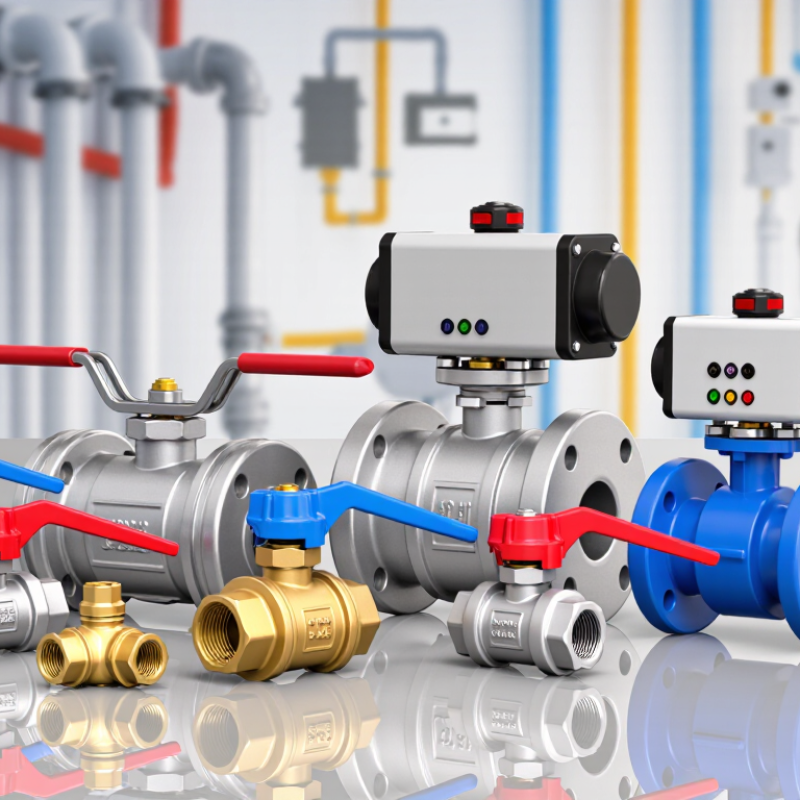
What Are the Best Ball Valves in 2026?

What Defines a Ball Valve: 90° Operation, Bore Design, and Core Parts

A ball valve controls flow by rotating a drilled sphere through 90 degrees. In the open position, the bore aligns with the pipe; a quarter-turn closes it. The simple motion is useful for quick isolation, but it does not make every ball valve suitable for frequent throttling. The main parts are the body, ball, stem, seats, and handle or actuator. Seats press against the ball to limit leakage, while the stem transfers rotation. Small details matter.

Bore design affects flow and sizing. A full-bore valve has an opening close to the connected pipe’s inside diameter, reducing restriction. A reduced-bore design narrows the passage and may suit space or cost constraints, but can add pressure loss.

The U.S. Department of Energy’s Improving Pumping System Performance sourcebook estimates that pumping systems may offer 25–50% energy-saving potential through system improvements. That figure applies to the whole system, not a valve alone. ISO 5208 also defines leakage-rate testing; Rate A requires no visually detectable leakage during the test. A test rating still cannot predict every installation.

Tips: Match bore, pressure rating, seat material, and media to actual service conditions. Check the valve’s test documentation, not just its label. That gets missed. A valve that turns smoothly on a bench may behave differently with sediment, heat, or frequent cycling.

Floating or Trunnion-Mounted: How Pressure and Size Shape the Choice

What Are the Best Ball Valves in 2026?

Floating or Trunnion-Mounted: How Pressure and Size Shape the Choice

A floating ball is held in place by its seats. As line pressure rises, the ball presses harder against the downstream seat, helping create a tight seal. This design often suits smaller valves and moderate pressures.

A trunnion-mounted ball is anchored at the top and bottom. Its seats move toward the ball, which can reduce operating torque in larger sizes or under high differential pressure. Neither design wins every time.

Pressure class matters as much as valve style. ASME B16.34 pressure-temperature tables list a typical carbon-steel Class 600 rating near 1,480 psi at ambient conditions; material and temperature change the allowable limit.

API 6D also provides design requirements for pipeline valves. Use the valve’s certified rating and the actual operating conditions, not nominal size alone. A small valve can still face demanding pressure, and a trunnion design is not automatically the safer choice.

Tips: Check pressure, temperature, fluid, cycle frequency, and actuator torque together. Compare the pressure drop across the closed valve, too. If the selection feels obvious, pause and verify the seat materials and test documentation; real systems can be less tidy than the catalog suggests.

How ASME B16.34 Ratings and API 598 Tests Compare Valve Performance

What Are the Best Ball Valves in 2026?

How ASME B16.34 Ratings and API 598 Tests Compare Valve Performance

A strong ball valve choice starts with pressure and temperature, not a catalogue headline. ASME B16.34-2020 assigns pressure-temperature ratings by material group and class. For Group 1.1 carbon steel, its rating table gives Class 150 a maximum working pressure of 285 psi at 100°F; Class 300 is rated 740 psi.

These figures are not universal: material, temperature, end connection, and valve design affect the rating. Check the exact table and operating conditions. A rating is not a guarantee.

API 598-2023 tests a different question: does the assembled valve hold pressure and limit leakage? It sets inspection requirements and shell and closure test procedures. Test duration varies with valve size, while acceptable seat leakage depends on seat construction and test conditions.

On a test bench, a shell test checks the pressure boundary; a closure test checks the seat. Useful distinction. A soft seat may show no visible leakage under the specified test, while metal-seat acceptance limits can differ.

Neither result predicts every field outcome. Cycling wear, debris, temperature swings, and installation can change performance. Compare the required B16.34 rating with documented API 598 test results, then verify both match the service.

One detail is easy to miss: passing a test does not prove long-term reliability.

Which Ball Valve Materials Suit Different Fluids and Temperature Ranges?

Ball-valve material selection starts with the fluid, but temperature and pressure can change the answer. Stainless steel resists many process fluids, yet chloride-rich water can still cause pitting, especially in warm service. Carbon steel can suit compatible, noncorrosive fluids, but moisture may bring rust and contamination. PTFE seats handle many chemicals; however, heat, pressure, and repeated cycling can cause deformation or wear. Metal seats may be preferable for hotter or abrasive service, though shutoff performance depends on the valve design. Small details matter.

Use the valve’s pressure-temperature rating, not a material’s headline temperature limit. ASME B16.34 provides pressure-temperature rating tables for valve materials and classes. IAPWS-IF97 steam-property data place water’s saturation temperature at 100°C at 0.101325 MPa; higher operating pressure raises that temperature. That matters when choosing body alloys and seats for steam. For carbon dioxide, NIST reports a critical temperature of about 31.0°C and pressure of 7.38 MPa, illustrating how quickly process conditions can shift near a phase boundary. Fluid labels alone are not enough. Confirm concentration, contaminants, pressure, cycling, and expected temperature swings against the valve’s documented limits. Ratings do not capture every installation detail, so the selection deserves a second look.

How API 607 Fire Tests and ISO 15848 Emissions Guide 2026 Selection

What Are the Best Ball Valves in 2026?
How API 607 Fire Tests and ISO 15848 Emissions Guide 2026 Selection

“Best” depends on the hazard, operating conditions, and evidence behind the specification. API 607 fire testing evaluates whether a qualifying quarter-turn valve limits leakage during and after fire exposure. It does not mean the valve remains leak-free or fully operable in every fire. Check the test report for the valve’s size, pressure, design, and tested configuration. Details matter. A rating without its test scope is weak evidence.

ISO 15848-1 classifies fugitive emissions performance through measured leakage, endurance cycles, and temperature classes. Compare those classifications with the plant’s operating temperature and expected cycling; do not treat an ISO class as a promise of zero emissions. The IEA’s Global Methane Tracker 2025 estimates energy-sector methane emissions reached about 120 million tonnes in 2024, underscoring why stem-seal performance deserves scrutiny. Ask for the actual test documentation, not only a catalog claim. That still leaves judgment: laboratory conditions cannot reproduce every installation, and real packing wear may change performance over time. A careful 2026 selection weighs both standards against the service conditions.

What Are the Best Ball Valves in 2026? - How API 607 Fire Tests and ISO 15848 Emissions Guide 2026 Selection
Service Requirement Suitable Ball-Valve Configuration API 607 Fire-Test Considerations ISO 15848 Emissions Considerations Selection Checks
General process isolation
Routine on/off service with moderate operating demands.
Floating-ball valve with resilient seats, where pressure, size, and operating torque are within the design limits. If fire-safe performance is required, verify an API 607 test report for the relevant valve design and configuration. A soft-seated design is not automatically fire-tested or fire-safe. For controlled fugitive emissions, request ISO 15848-1 type-test results for the stem sealing arrangement and applicable operating conditions. Check pressure–temperature limits, seat material compatibility, end connections, shutoff requirements, and whether the tested design matches the supplied valve.
Higher pressure or larger-bore isolation
Applications where operating torque and pressure loads are significant.
Trunnion-mounted ball valve, selected to suit line size, pressure class, differential pressure, and required operating method. Confirm API 607 qualification for the specific design. Test evidence should identify relevant size, pressure, materials, and construction limits rather than being assumed to cover every variant. Review ISO 15848-1 type-test data for the stem seal and any other evaluated sealing points. Consider ISO 15848-2 when production acceptance testing is specified. Check cavity-pressure relief or self-relieving seat design, actuator sizing, seat leakage requirements, and the permitted test envelope.
Fire-exposed service
Installations where fire-tested valve performance is specified by the project or applicable rules.
A ball valve with a documented fire-test qualification and construction details suitable for the intended service. API 607 is a fire-test standard for quarter-turn valves and valves equipped with nonmetallic seats. Verify the test standard, report scope, and applicability to the selected valve configuration. Fire-test qualification and fugitive-emissions qualification address different performance questions. Obtain separate emissions evidence if low leakage to atmosphere is also required. Confirm the required standard and edition in the project specification, materials, end connections, size and pressure coverage, and installation conditions.
Low fugitive-emissions service
Use where stem or body emissions limits are part of the specification.
A valve design with a stem-sealing system supported by applicable emissions type-test documentation; packing selection should match the service. Where fire performance is also required, verify API 607 evidence independently. Passing one standard does not establish compliance with the other. ISO 15848-1 provides type-testing and classification for fugitive emissions from industrial valves. Compare the specified tightness class, temperature class, and endurance class with the service requirement. Check test medium, temperature range, cycling conditions, packing configuration, adjustment instructions, and whether the supplied design is equivalent to the tested design.
High-cycle or demanding operating duty
Frequent cycling or conditions that may accelerate seal wear.
Choose the ball, seats, stem seals, and actuation system for the actual cycle frequency, fluid, pressure, and temperature; no single construction is best for every duty. Ask whether the fire-test qualification applies to the same materials and configuration being offered, especially where design options vary. Use ISO 15848-1 endurance-test information to assess tested cycling performance. ISO 15848-2 may be specified for production acceptance testing; it is not a substitute for type-test evidence. Review expected cycles, maintenance intervals, operating torque, fluid cleanliness, and the purchaser’s acceptance criteria.
Low-temperature or cryogenic service
Service where cold-temperature operation and external sealing are critical.
Purpose-designed low-temperature or cryogenic ball valve, with materials, clearances, seats, and stem arrangement selected for the specified temperature range. Fire-test evidence does not by itself establish suitability for low-temperature service. Check that the design and materials meet the required temperature conditions. Confirm that emissions test temperatures and sealing configuration are relevant to the specified operating range; do not infer low-temperature performance from a test at a different temperature. Verify material impact properties, thermal contraction allowances, stem extension requirements, seat behavior, and applicable pressure–temperature ratings.

How to use this table: “Best” depends on the process conditions and the project specification. API 607 fire-test evidence and ISO 15848 emissions results are separate qualifications. Request test documentation and confirm its scope matches the valve size, pressure rating, materials, seals, and configuration being purchased.

Top
error: Content is protected !!