
Quality Products
At a Fair Price
Wholesale Provider
Of Valves & Fittings
- HOME
- Products
- Ball Valves
- Bull Plugs & Swages
- Butterfly Valves
- Check Valves
- Cushion / Flow Tees & Bleed Rings
- Enhanced Oil Recovery
- Floating Ball Valves
- Foot Valves
- Forged Steel Fittings
- Forged Steel Outlets
- Gaskets-Insulation Kits
- Gate Valves
- Gate, Globe & Check Valves
- Malleable Fittings
- Needle Valves
- Nipples
- Piston Valves
- Plug Valves
- Stainless Steel Flanges, Fittings & Nipples
- Strainers
- Studs
- Trunnion
- Unions
- Weld Fittings & Flanges
- Manufacturers
- Advance
- American Block
- Anvil
- Balon
- Bonney Forge
- Champion
- Clayton Mark
- Crane
- Daniel
- DMIC
- GMI
- Galli & Cassina
- Hackney-Ladish
- JMC
- Lone Star
- MATCO
- Marpac-McCanna
- National Flange
- National Gasket
- Nordstrom
- Nutron
- PPI
- SHARPE
- SMI
- TEXSTEAM
- TEX-THREAD
- Titan
- USA Fastner
- Vogt
- Weld Bend
- Westbrook
- Wheatley
- Williams
- WKM
- Wolar
- Locations
- Contact
- Blog
- Careers
- Get a Quote
- HOME
- Products
- Ball Valves
- Bull Plugs & Swages
- Butterfly Valves
- Check Valves
- Cushion / Flow Tees & Bleed Rings
- Enhanced Oil Recovery
- Floating Ball Valves
- Foot Valves
- Forged Steel Fittings
- Forged Steel Outlets
- Gaskets-Insulation Kits
- Gate Valves
- Gate, Globe & Check Valves
- Malleable Fittings
- Needle Valves
- Nipples
- Piston Valves
- Plug Valves
- Stainless Steel Flanges, Fittings & Nipples
- Strainers
- Studs
- Trunnion
- Unions
- Weld Fittings & Flanges
- Manufacturers
- Advance
- American Block
- Anvil
- Balon
- Bonney Forge
- Champion
- Clayton Mark
- Crane
- Daniel
- DMIC
- GMI
- Galli & Cassina
- Hackney-Ladish
- JMC
- Lone Star
- MATCO
- Marpac-McCanna
- National Flange
- National Gasket
- Nordstrom
- Nutron
- PPI
- SHARPE
- SMI
- TEXSTEAM
- TEX-THREAD
- Titan
- USA Fastner
- Vogt
- Weld Bend
- Westbrook
- Wheatley
- Williams
- WKM
- Wolar
- Locations
- Contact
- About
- Careers
- Get a Quote
7 Tips for Buying a Peripheral Driving Thickener?
Buying a Peripheral Driving Thickener is not simply a matter of choosing the largest tank. It is a process decision involving ore behavior, water recovery, torque, maintenance, and site conditions. USGS Mineral Commodity Summaries 2025 shows continuing global demand for mined materials, while water stewardship remains a major operational concern in the mining sector. Reports from the International Council on Mining and Metals also emphasize stronger water efficiency and responsible reuse.
A thickener may look calm from the walkway. Inside, clay, flocculant, and changing solids concentration can create unstable settling. That is why laboratory settling tests and pilot trials matter. Barry A. Wills, a recognized mineral-processing author, states: “The objective of thickening is to produce a thick pulp containing most of the solids and a clear liquid.” This principle remains practical when comparing underflow density, overflow clarity, and rake torque.
Seven buying considerations deserve close attention: feed characteristics, tank diameter, drive capacity, rake-lift protection, flocculant control, instrumentation, and after-sales support. Check real operating references. Ask for data from similar ore, not only ideal test conditions. A glossy datasheet is not enough. It can hide uncertainty.
The difficult part is prediction. Ore properties change. Seasonal water quality changes. My own recommendation is cautious: compare lifecycle performance, not purchase price alone. A cheaper Peripheral Driving Thickener may demand more maintenance, energy, or operator attention over time. That assumption can fail, so buyers should verify every critical claim through testing, documented references, and independent engineering review.
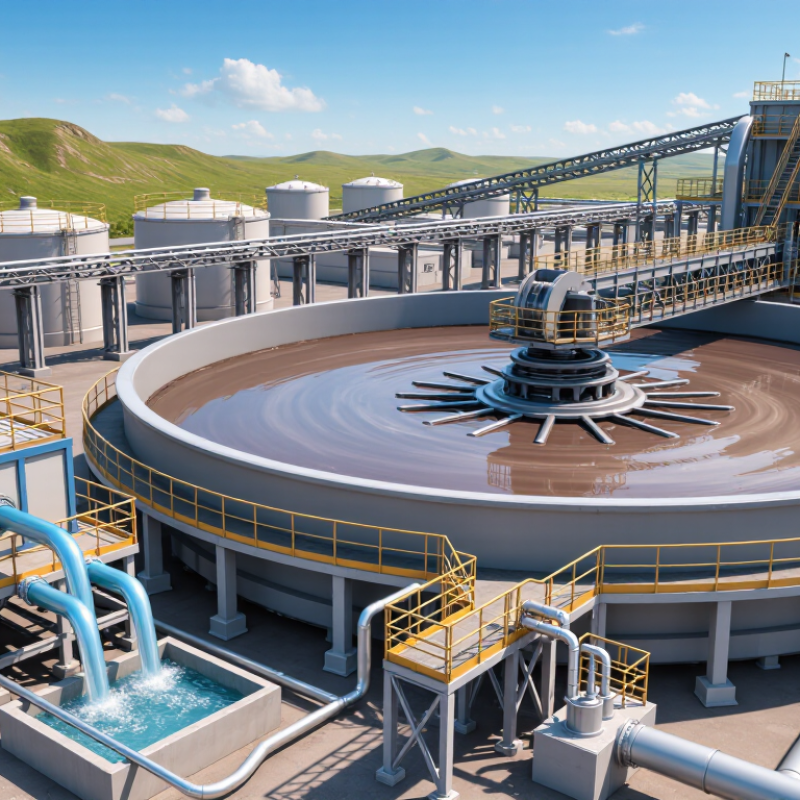
What Is a Peripheral Driving Thickener and How Does It Work?
A peripheral-drive thickener is a circular sedimentation unit used to concentrate suspended solids. Its drive mechanism sits near the tank rim. The motor turns a bridge and scraper assembly around the basin. Wastewater enters through a central feedwell, which reduces turbulence. Heavier particles settle slowly toward the bottom. Clearer liquid flows over the peripheral weir. Thickened sludge exits through a bottom outlet. The scraper moves settled solids toward that outlet.
When buying one, match the equipment to actual flow, solids loading, and tank diameter. A larger tank does not automatically provide better thickening. Ask for calculated torque, bridge load, and scraper speed. These figures reveal whether the drive can handle changing sludge conditions. Check the tank material, weld quality, and corrosion protection. Inspect the overload device and emergency stopping method. Small protection details can prevent expensive damage.
Reliable operation also depends on access. Review walkways, handrails, covers, and maintenance clearance before approval. Request drawings, operating data, and performance assumptions in writing. Compare expected underflow concentration with results from similar applications. Be cautious with optimistic numbers. Real plant conditions often differ from laboratory tests. I would also examine the control system, because simple alarms are easier to understand during a fault. Do not ignore winter conditions, grit, or uneven loading. These factors may expose weaknesses that appear invisible during a clean-water demonstration.
How to Match Thickener Design with Material and Processing Requirements
7 Tips for Buying a Peripheral Driving Thickener
Tip 1: Identify the material before comparing equipment. Sludge, mineral slurry, and food residue behave differently in a tank. Measure solids concentration, particle size, viscosity, temperature, and corrosiveness. A thickener designed for light sludge may struggle with abrasive mineral feed.
Tip 2: Match the rake and drive to the material. Dense solids require stronger torque and slower movement. Tip 3: Check the tank diameter and effective settling area. These dimensions influence residence time and overflow clarity. Tip 4: Examine the feedwell design. A calm, evenly distributed feed reduces turbulence and improves settling.
Tip 5: Consider the underflow target, not only capacity. If the process needs a thicker discharge, review bed depth, rake clearance, and withdrawal control. Tip 6: Ask for material compatibility details. Stainless steel, coated carbon steel, and polymer components each suit different chemical conditions. Seals and bearings deserve equal attention. Tip 7: Request test data using your actual material. Laboratory results are useful, but field behavior can differ. I once underestimated seasonal viscosity changes, and the selected drive lacked enough operating margin. That mistake was expensive. Leave room for variation. Also inspect cleaning access, instrumentation, emergency protection, and maintenance space before purchase. A compact design may save floor area but complicate repairs. Reliable suppliers should explain assumptions, operating limits, and expected performance in writing. The best match is not the largest machine. It is the design that remains stable when feed conditions become imperfect.
7 Tips for Buying a Peripheral Driving Thickener? - How to Match Thickener Design with Material and Processing Requirements
| No. | Buying Tip | Material and Feed Conditions | Key Process Requirements | Recommended Design Considerations | Practical Data to Confirm Before Purchase |
|---|---|---|---|---|---|
| 1 | Define the solids loading and particle behavior | Feed slurries may contain fine mineral particles, clay, organic solids, or flocculated material. Particle size, density, shape, and settling rate strongly affect torque and rake performance. | The thickener must produce a clarified overflow and a stable underflow without excessive solids carryover. | High-torque rake Adequate bed area Use laboratory settling tests to determine the required unit area. A higher solids concentration and slower settling behavior generally require more surface area. | Record feed solids concentration by mass, particle-size distribution, solids density, settling velocity, and expected underflow concentration. Do not size the unit from liquid flow alone. |
| 2 | Match the tank diameter to the available flow and duty | Hydraulic loading varies with ore type, reagent program, temperature, and upstream classification efficiency. | Surface overflow rate must remain low enough to allow solids to settle while maintaining the target throughput. | Correct settling area Uniform feed distribution Select tank diameter from tested unit-area requirements and design flow. Oversized or undersized tanks can both create unstable operation if feed distribution is poor. | Confirm normal, peak, and minimum feed flow; hydraulic retention expectations; allowable overflow-solids concentration; and the design margin for future capacity changes. |
| 3 | Select the drive for torque, not only for motor power | Dense underflow, compacted beds, coarse particles, and intermittent feeding can create high rake resistance and start-up loads. | The rake must continuously move settled solids toward the discharge cone and restart safely after a trip or power interruption. | Torque protection Variable-speed control A peripheral drive should include suitable reduction gearing, overload protection, torque monitoring, and a controlled start arrangement. The rated torque should reflect peak bed conditions, not only normal running torque. | Obtain normal and maximum rake torque, start-up torque, drive speed range, alarm and trip settings, emergency lifting or rake-raising provisions, and the allowable number of starts per hour. |
| 4 | Choose construction materials for corrosion and abrasion | Chlorides, acidic process water, dissolved metals, abrasive silica, and coarse mineral particles can shorten equipment life. | Mechanical parts must maintain structural strength and alignment throughout continuous service and cleaning cycles. | Corrosion allowance Wear protection Specify suitable carbon steel, stainless steel, coated steel, or abrasion-resistant components according to the chemical and abrasive duty. Protect the tank floor, feedwell, rake arms, and discharge zone where required. | Provide pH, chloride level, temperature, reagent composition, abrasive mineral content, expected wear rate, coating system, and inspection or replacement intervals. |
| 5 | Evaluate feedwell and flocculation performance | Flocculated fine solids are sensitive to shear. Poor reagent dispersion or excessive turbulence can break flocs and increase overflow turbidity. | Feed must be distributed evenly below the liquid surface while dissipating incoming energy and minimizing short-circuiting. | Low-shear feedwell Adjustable feed dilution Match feedwell volume, inlet arrangement, energy-dissipation features, and flocculant injection points to the slurry rheology and flow rate. Provide access for inspection and cleaning. | Confirm feedwell diameter and volume, inlet velocity, dilution-water availability, flocculant type and dosage range, mixing energy, and expected overflow turbidity. |
| 6 | Check underflow withdrawal and discharge reliability | High-density underflow may be viscous, compressible, or prone to consolidation and blockage, especially during low-flow operation. | The discharge system must maintain the target underflow density without flooding the tank or allowing excessive bed accumulation. | Reliable cone outlet Density control Size the outlet, valves, pumps, and instruments for the expected rheology. Consider multiple withdrawal points, dilution capability, pressure measurement, and a controlled underflow loop where appropriate. | Confirm target underflow density, yield stress or viscosity, minimum withdrawal rate, pump head, pipe velocity, outlet diameter, flushing method, and blockage response procedure. |
| 7 | Verify instrumentation, maintenance, and site conditions | Process variability and outdoor exposure can affect level measurement, torque signals, lubrication, electrical equipment, and structural components. | Stable operation depends on early detection of high torque, rising bed level, low underflow flow, overflow turbidity, and drive faults. | Online monitoring Maintainable layout Include bed-level measurement, torque indication, underflow-density monitoring, overflow sampling, accessible walkways, lifting points, drainage, and weather protection appropriate to the installation site. | Confirm ambient temperature, wind and seismic design criteria, power supply, control-system interfaces, lubrication schedule, spare parts, inspection access, lifting capacity, and operator training requirements. |
Note: Final thickener sizing and peripheral-drive selection should be based on representative settling, compression, and rheology testing under expected operating conditions. Values such as tank area, rake torque, underflow density, and drive power are application-specific and should be verified by the equipment designer.
Which Capacity, Tank Size, and Operating Speed Should You Choose?
When buying a peripheral driving thickener, capacity should match actual sludge production, not a hopeful forecast. The U.S. EPA’s Process Design Manual: Sludge Treatment and Disposal reports typical gravity-thickener solids loading rates of about 20–40 kg/m²·day, depending on sludge type. Measure daily solids first. Then allow room for seasonal peaks and process upsets.
Tank size affects settling time, hydraulic loading, and maintenance access. A larger diameter can reduce surface loading, but an oversized tank may create poor sludge movement and unnecessary construction cost. WEF’s Design of Municipal Wastewater Treatment Plants recommends checking both solids loading and overflow rate during design.
Operators should also examine feedwell depth, hopper angle, and withdrawal piping. Small details matter. A sticky sludge can behave very differently from laboratory samples.
Operating speed needs careful control. Many gravity thickeners use slow rake speeds, commonly around 0.05–0.15 rpm, to release water without disturbing the sludge blanket. Higher speed is not automatically better. It can increase torque, break flocs, and return suspended solids to the overflow.
Select the drive from measured torque, peak solids concentration, and starting conditions. Include overload protection and variable-speed control. I would not choose the smallest motor merely because average torque looks acceptable. That calculation often misses cold starts and sudden sludge surges. Check the data twice.
How to Evaluate Drive Systems, Maintenance Needs, and Equipment Reliability
7 Tips for Buying a Peripheral Driving Thickener
A peripheral drive thickener should be judged by its drive system, not only its tank diameter. The U.S. Department of Energy reports that pumping systems can consume 20–25% of industrial electricity. Choose an efficient motor, correctly sized gearbox, and variable-speed control. Ask for continuous torque data, overload settings, and emergency-stop performance. A torque alarm is useful. It cannot replace inspection.
Check the drive trolley, rail, wheels, bearings, and rack alignment. Uneven concrete can create vibration and concentrated wheel loads. WEF Manual of Practice No. 8 stresses routine inspection of collector mechanisms and torque protection. Request corrosion allowances, coating specifications, and access points for lubrication. Maintenance should not require unsafe climbing or dismantling half the machine. That sounds obvious. It is often missed.
Review the supplier’s failure records, spare-parts lead times, and commissioning procedures. ISO 55000-based asset management guidance supports decisions using lifecycle cost, risk, and maintainability. Compare annual lubrication hours, gearbox replacement intervals, and expected power use. Ask for references from plants with similar sludge density and climate. Field conditions are rarely perfect. One weakness remains: laboratory torque tests may not represent grit, cold weather, or uneven sludge loading. Require a documented factory test, site acceptance test, and clear warranty exclusions. Inspectors should record noise, temperature, current, and vibration during the first operating month.
What Safety Standards, Supplier Services, and Costs Should You Compare?
Buying a peripheral-drive thickener requires more than comparing tank diameter and quoted price. Check ISO 12100 risk assessment, IEC 60204-1 electrical protection, and OSHA 1910.147 lockout procedures. OSHA reports that effective lockout/tagout can prevent about 120 deaths and 50,000 injuries yearly. Ask whether the bridge includes guarded drives, emergency stops, overload protection, and safe access around the rake mechanism. Operators should see test records, not only compliance claims.
Supplier service can decide whether the equipment remains useful after installation. Compare process design, sludge testing, factory acceptance testing, commissioning, training, and spare-parts availability. Request documented torque calculations for peak sludge loading. Ask for response times during breakdowns. A practical supplier should explain how the thickener handles changing solids concentration, cold weather, and uneven feeding. These details matter because wastewater plants often operate continuously. The Global Water Intelligence Global Water Market report identifies rising treatment investment, but investment does not guarantee reliable local support.
Cost comparison should include the complete life cycle. Separate equipment, civil works, controls, freight, installation, energy, maintenance, and replacement parts. EPA energy guidance commonly places energy among the major wastewater operating costs, so review motor efficiency and rake-drive power. Obtain a five-year ownership estimate, not just a purchase price. One weakness remains: sludge conditions rarely stay constant. I would test assumptions with site data, yet even good data can miss seasonal changes. A low bid may become expensive when commissioning support, gearbox repairs, or redesign work are excluded.
