
Quality Products
At a Fair Price
Wholesale Provider
Of Valves & Fittings
- HOME
- Products
- Ball Valves
- Bull Plugs & Swages
- Butterfly Valves
- Check Valves
- Cushion / Flow Tees & Bleed Rings
- Enhanced Oil Recovery
- Floating Ball Valves
- Foot Valves
- Forged Steel Fittings
- Forged Steel Outlets
- Gaskets-Insulation Kits
- Gate Valves
- Gate, Globe & Check Valves
- Malleable Fittings
- Needle Valves
- Nipples
- Piston Valves
- Plug Valves
- Stainless Steel Flanges, Fittings & Nipples
- Strainers
- Studs
- Trunnion
- Unions
- Weld Fittings & Flanges
- Manufacturers
- Advance
- American Block
- Anvil
- Balon
- Bonney Forge
- Champion
- Clayton Mark
- Crane
- Daniel
- DMIC
- GMI
- Galli & Cassina
- Hackney-Ladish
- JMC
- Lone Star
- MATCO
- Marpac-McCanna
- National Flange
- National Gasket
- Nordstrom
- Nutron
- PPI
- SHARPE
- SMI
- TEXSTEAM
- TEX-THREAD
- Titan
- USA Fastner
- Vogt
- Weld Bend
- Westbrook
- Wheatley
- Williams
- WKM
- Wolar
- Locations
- Contact
- Blog
- Careers
- Get a Quote
- HOME
- Products
- Ball Valves
- Bull Plugs & Swages
- Butterfly Valves
- Check Valves
- Cushion / Flow Tees & Bleed Rings
- Enhanced Oil Recovery
- Floating Ball Valves
- Foot Valves
- Forged Steel Fittings
- Forged Steel Outlets
- Gaskets-Insulation Kits
- Gate Valves
- Gate, Globe & Check Valves
- Malleable Fittings
- Needle Valves
- Nipples
- Piston Valves
- Plug Valves
- Stainless Steel Flanges, Fittings & Nipples
- Strainers
- Studs
- Trunnion
- Unions
- Weld Fittings & Flanges
- Manufacturers
- Advance
- American Block
- Anvil
- Balon
- Bonney Forge
- Champion
- Clayton Mark
- Crane
- Daniel
- DMIC
- GMI
- Galli & Cassina
- Hackney-Ladish
- JMC
- Lone Star
- MATCO
- Marpac-McCanna
- National Flange
- National Gasket
- Nordstrom
- Nutron
- PPI
- SHARPE
- SMI
- TEXSTEAM
- TEX-THREAD
- Titan
- USA Fastner
- Vogt
- Weld Bend
- Westbrook
- Wheatley
- Williams
- WKM
- Wolar
- Locations
- Contact
- About
- Careers
- Get a Quote
2026 Top Welded Steel Pipe Types for Global Buyers
Choosing the right Welded Steel Pipe in 2026 is not simply a price comparison. Global buyers must match pipe type, manufacturing method, steel grade, diameter, wall thickness, and end-use conditions. ERW pipe may suit water lines, structural frames, and moderate-pressure systems. LSAW pipe offers strong dimensional control for large-diameter transmission projects. SSAW pipe can provide production flexibility, especially for long infrastructure routes. Galvanized and stainless welded options add protection where corrosion risks are severe.
The details matter.
Edwin Basson, Director General of the World Steel Association, has said, “Steel is the most widely used metal in the world.” That perspective explains why buyers should evaluate more than appearance or mill price. Factory audits, heat-number traceability, weld inspection, hydrostatic testing, and material certificates can reveal differences hidden beneath a clean surface. Experienced procurement teams also check applicable specifications, coating systems, port handling requirements, and supplier response times.
Still, no universal ranking fits every market. A pipe suitable for buried drainage may fail in a high-pressure energy application. A low-cost offer may become expensive after coating repairs, delayed documentation, or rejected welds. This guide examines the leading welded pipe types for global buyers, including their practical strengths, limitations, and purchasing risks. Some distinctions remain easy to overlook. That is where careful review matters.
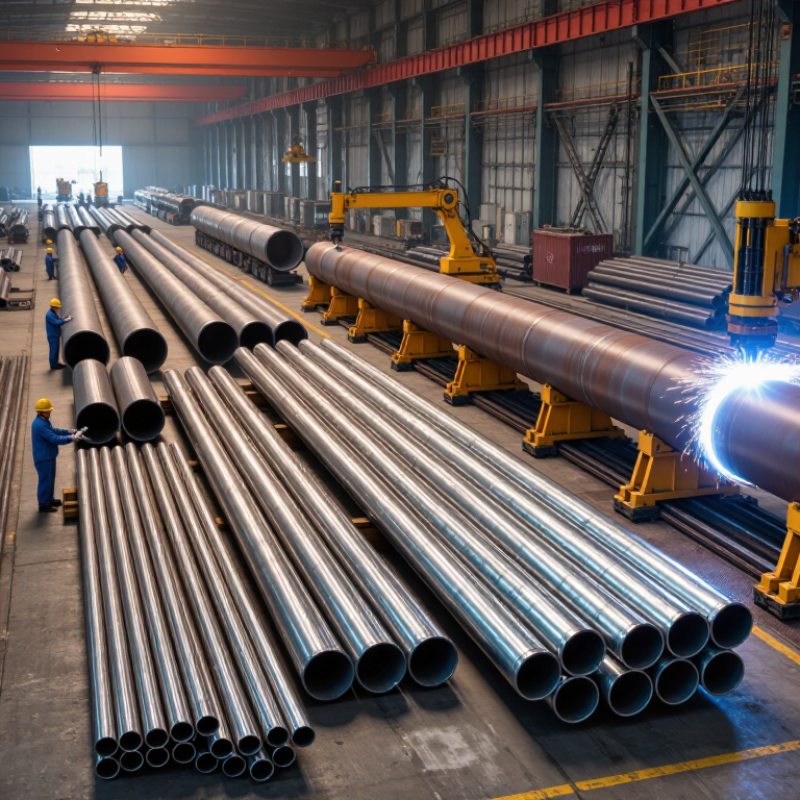
Welded Steel Pipe Basics and Classification Criteria
Welded steel pipes are formed from steel plate or coil, then joined along a seam. The welding method strongly affects their suitable applications. Electric resistance welded pipes usually have a straight seam and consistent dimensions. Longitudinal submerged arc welded pipes suit large diameters and demanding structural work. Spiral submerged arc welded pipes can provide wide diameter options, but seam geometry requires careful inspection.
Buyers should classify pipe by manufacturing process, outside diameter, wall thickness, steel grade, and end finish. Service conditions matter too. A pipe carrying water differs from one exposed to pressure, soil, or elevated temperatures. Check the required standard, heat number, chemical report, tensile results, and hydrostatic test records. Visual checks should include weld appearance, ovality, dents, and coating damage. Small defects can become expensive problems.
In practical purchasing, I compare the design pressure with the actual wall thickness, not only the catalog description. Threaded, plain, and beveled ends each change installation requirements. Internal lining and external coating may be necessary in corrosive environments. Classification is not always neat. A low-cost pipe can look suitable until tolerances, inspection levels, or delivery conditions are reviewed. Buyers should also confirm traceability from steel coil to finished pipe, because paperwork without matching markings is weak evidence. Ask for independent inspection when the application has little room for failure.
2026 Top Welded Steel Pipe Types for Global Buyers - Welded Steel Pipe Basics and Classification Criteria
| Pipe type | Manufacturing method | Typical outside diameter range* | Typical wall-thickness capability* | Common standards or specifications | Typical applications | Main buying considerations |
|---|---|---|---|---|---|---|
| ERW pipe | Cold-formed strip or plate is joined along a longitudinal seam using electric resistance heating and pressure. | Approximately 20–610 mm (0.75–24 in), depending on mill configuration. | Approximately 1.5–16 mm. | ASTM A53, ASTM A500/A500M, EN 10219, API 5L and ISO 3183 where specified. | Water lines, structural columns, mechanical tubing, low- and medium-pressure service, and general fabrication. | Verify seam quality, weld inspection, dimensional tolerance, end finish, coating, and applicable pressure or structural requirements. |
| HFW pipe | A high-frequency electric current heats the strip edges, which are forced together to form a longitudinal weld; it is commonly treated as a high-frequency form of ERW. | Approximately 20–610 mm, subject to production line capacity. | Commonly about 2–16 mm. | API 5L, ISO 3183, EN 10217-1, and project-specific requirements. | Transmission and process pipelines, line pipe, boiler or pressure-service applications when the required grade and testing are specified. | Check heat treatment of the seam, weld-line inspection, hydrostatic testing, nondestructive testing, and PSL or delivery class. |
| LSAW pipe | A wide plate is formed into a cylinder and welded longitudinally, usually by submerged arc welding; forming may use JCOE, UOE, or related processes. | Approximately 406–1,422 mm (16–56 in). | Approximately 6–40 mm, with larger thicknesses available for some projects. | API 5L, ISO 3183, ASTM A671/A672 for specified services, and EN 10217-5. | Large-diameter oil and gas transmission lines, water transmission, structural piles, penstocks, and offshore or onshore infrastructure. | Confirm plate grade, weld procedure qualification, seam location, ultrasonic or radiographic testing, roundness, straightness, and impact-test requirements. |
| SSAW / HSAW spiral-welded pipe | Hot-rolled coil is helically formed and joined with submerged arc welding along a spiral seam. | Approximately 219–3,200 mm (8–126 in), depending on equipment and project requirements. | Approximately 5–25 mm; project limits vary. | API 5L, ISO 3183, ASTM A252 for piling, EN 10217-5, and regional water-pipe specifications. | Water mains, low- to medium-pressure pipelines, piling, dredging lines, structural applications, and large-diameter utility systems. | Evaluate spiral seam geometry, allowable operating pressure, coil chemistry, weld testing, coating system, and suitability for cyclic or high-pressure service. |
| Double-submerged-arc-welded pipe | The longitudinal or spiral joint is welded from both inside and outside with submerged arc welding to provide a deep, controlled weld profile. | Commonly about 406–1,422 mm for longitudinal production and up to approximately 3,200 mm for spiral production. | Often about 6–40 mm, subject to the approved manufacturing procedure. | API 5L, ISO 3183, EN 10217-5, ASTM A671/A672, and project-specific pipeline codes. | High-integrity transmission lines, water infrastructure, offshore structures, and heavy-wall pipe systems. | Review weld repair limits, full-length ultrasonic or radiographic examination, hydrotest pressure, toughness, sour-service requirements, and traceability. |
| Structural welded pipe | Usually produced by ERW, HFW, LSAW, or SSAW processes and supplied primarily for load-bearing rather than pressure-service duties. | Approximately 20–3,200 mm, depending on section, process, and specification. | Approximately 2–40 mm for common commercial products. | ASTM A500/A500M, ASTM A252, EN 10219, EN 10210 where applicable, and regional structural standards. | Building columns, bridge components, traffic structures, piling, towers, machinery frames, and temporary works. | Specify yield strength, tensile strength, impact class, buckling design, section dimensions, straightness, welding suitability, and corrosion protection. |
| Pressure-service welded pipe | ERW, HFW, LSAW, or SSAW pipe manufactured under a pressure-pipe specification with defined weld, testing, and inspection controls. | Typically about 20–1,422 mm; the permissible range depends on the selected standard and grade. | Selected to meet design pressure, temperature, corrosion allowance, and code requirements rather than a single universal range. | ASTM A53, ASTM A671/A672, EN 10217, API 5L, ISO 3183, and applicable national pressure codes. | Steam, water, process fluids, gas transmission, power plants, refineries, and industrial piping. | Define design pressure and temperature, fluid category, corrosion mechanism, weld examination level, hydrotest, impact testing, and certification documents. |
| Coated welded pipe | A welded steel pipe receives an external or internal protective system such as fusion-bonded epoxy, three-layer polyethylene, three-layer polypropylene, or cement mortar lining. | The diameter range follows the underlying ERW, LSAW, or SSAW pipe; approximately 20–3,200 mm is common across projects. | Determined by the base pipe and design loads; coating thickness is specified separately. | ISO 21809 series, AWWA C213/C210 where applicable, EN 10289, DIN 30670, and project coating specifications. | Buried pipelines, potable-water systems, marine exposure, wastewater, and corrosive industrial environments. | Confirm surface preparation, coating thickness, holiday testing, adhesion, operating temperature, field-joint coating, lining compatibility, and handling restrictions. |
ERW Steel Pipes for General Industrial and Construction Use
ERW steel pipes remain practical choices for general industrial and construction use in 2026. They are formed by rolling steel strip and joining the seam with electric resistance heat. This process supports consistent dimensions, fast production, and competitive pricing. Common applications include water lines, scaffolding, structural frames, machinery supports, and low-pressure service piping.
The World Steel Association reported global crude steel production of about 1.89 billion tonnes in 2023. This scale supports a broad supply base for welded pipe products. The International Energy Agency’s 2024 Global Status Report for Buildings and Construction also noted that buildings account for roughly 30% of global energy demand. Efficient material selection therefore matters during large construction projects. ERW pipes can reduce cutting waste when lengths and wall thicknesses match the design. Yet a lower purchase price may hide poor ovality, weak weld control, or inconsistent coating thickness. That part is easy to overlook.
Tips: Confirm the required standard, outside diameter, wall thickness, grade, and end finish before ordering. Request mill certificates and dimensional inspection records. For outdoor use, check coating adhesion and corrosion protection. Do not assume every ERW pipe suits pressure service. Verify the design pressure, temperature, fluid, and applicable standard with a qualified engineer. A small sampling mistake can become an expensive site problem.
2026 Top Welded Steel Pipe Types for Global Buyers: ERW Steel Pipes for General Industrial and Construction Use
Common ERW steel pipe nominal sizes shown by standard outside diameter. These sizes are widely used in industrial piping, structural supports, water systems, and general construction.
The outside diameters are based on commonly referenced ASME B36.10 nominal pipe size dimensions. Actual ERW availability, wall thickness, grade, coating, and length may vary according to the applicable project specification and local standard.
LSAW and SSAW Pipes for Large-Diameter Applications
2026 Top Welded Steel Pipe Types for Global Buyers
Large-diameter projects increasingly compare LSAW and SSAW pipes by service conditions, not price alone. The World Steel Association reported 1.89 billion tonnes of crude steel production in 2023. That scale supports broad pipe availability, but it does not guarantee consistent quality.
LSAW pipes use longitudinal welding and usually offer strong dimensional control. They suit demanding water, energy, and structural applications. SSAW pipes use spiral forming, allowing efficient production of long, large-diameter sections. Their flexibility can reduce material waste and delivery pressure.
Worldsteel’s October 2024 Short Range Outlook projected global steel demand growth of 1.9% in 2024 and 1.2% in 2025. This slower growth makes procurement discipline more important. Buyers should check diameter, wall thickness, steel grade, weld inspection, hydrostatic testing, and coating compatibility. ISO 3183, API 5L, and EN 10217 may apply, depending on the project and destination. LSAW is not automatically better. SSAW is not automatically cheaper after installation. Field engineers should review seam orientation, pressure class, soil conditions, and joining methods before approval. A low quotation can hide costly testing gaps. My own caution is simple: technical sheets often look complete, yet missing impact data or traceability can change the decision.
Specialized Welded Pipes for Oil, Gas, and Structural Projects
2026 Top Welded Steel Pipe Types for Global Buyers
Specialized welded pipes serve different demands across oil, gas, and structural projects. ERW pipes suit many medium-diameter applications with consistent wall thickness and efficient production. HFW pipes offer clean weld profiles for demanding service conditions. For larger diameters, LSAW and SSAW pipes provide practical options for transmission lines and heavy infrastructure. Selection should follow pressure, diameter, wall thickness, temperature, and installation conditions.
Oil and gas buyers should request documented chemistry, weld procedures, heat numbers, and traceable inspection records. Hydrostatic testing, ultrasonic testing, radiographic testing, and dimensional checks can expose defects before delivery. Standards such as API 5L, ASTM specifications, or project-specific requirements may apply. However, compliance depends on the exact grade, service environment, and purchaser specification. A certificate alone is not enough.
Structural projects often use welded pipes for columns, piles, bridges, and equipment supports. High-strength grades can reduce weight, but welding quality remains critical. Check straightness, ovality, coating condition, and end preparation during inspection. Small surface damage can become serious after transport or field welding. No pipe fits every project. In practice, buyers may overvalue price and overlook logistics, repair procedures, or local fabrication skills. That choice deserves a second look. Reliable procurement combines technical review, independent inspection, clear tolerances, and realistic delivery planning.
Global Buying Factors: Standards, Coatings, Sizes, and Suppliers
2026 Top Welded Steel Pipe Types for Global Buyers
Global buyers comparing welded steel pipe in 2026 should start with standards, not price. Specify the required system, such as API, ASTM, EN, or ISO, and confirm the latest project edition. Standard names alone are insufficient. Define chemical limits, tensile strength, impact testing, weld inspection, dimensional tolerance, and hydrostatic pressure. Ask for mill certificates and independent test reports when risk is high. A neat certificate is not proof of every batch. Traceability matters.
Coating selection follows soil, water, temperature, and installation method. Bare pipe may suit sheltered indoor service, while 3LPE, epoxy, galvanized, or internal linings serve harsher exposure. Check coating thickness, holiday testing, adhesion, repair procedures, and end protection. Small scratches can become expensive corrosion points. Do not assume thicker is always better. A coating can fail when surface preparation is poor or curing occurs in damp weather. This detail is often missed.
Sizes need more than outside diameter. Confirm wall thickness, length range, bevel angle, ovality, and actual weight tolerance. For fluid lines, calculate pressure loss and flow capacity; for structural use, check load assumptions. Supplier evaluation should cover production capacity, inspection access, delivery records, and clear claims handling. Request packing photos and a realistic lead time. Cheap offers can hide exclusions. Buyers sometimes over-specify every feature, raising costs without improving service. A disciplined supplier explains trade-offs, admits limits, and documents each deviation before shipment.
