
2026 Top Folding Mesh Door Types for Global Buyers
For global buyers, choosing a Folding Mesh Door is not simply a matter of comparing prices. It involves airflow, visibility, insect control, installation space, and daily operating habits. In a coastal warehouse, salt air may weaken ordinary hardware. In a busy café, a narrow track can collect crumbs and dust. These small details often decide whether a door performs well after six months.
Michael A. O’Brien, a door-systems consultant with more than two decades of field experience, says, “The best mesh door is the one that fits the opening, the traffic, and the maintenance reality.” That practical view guides this 2026 overview. It examines pleated, accordion, retractable, magnetic, and heavy-duty Folding Mesh Door types for residential, commercial, and light industrial buyers. Each model offers advantages, but none is perfect. A magnetic closure may be convenient, yet it can lose alignment under constant use. A reinforced frame may improve durability, but it can increase shipping weight and installation effort.
Performance also depends on details beyond the mesh itself. Check the rail profile, mesh density, frame material, replacement parts, warranty terms, and supplier support. Confirm measurements carefully. A few millimeters matter. Buyers should also consider local climate, doorway frequency, cleaning routines, and accessibility needs. Product photographs can mislead. Real performance appears at the threshold, where dust, wind, hands, carts, and repeated opening meet. This guide aims to make that comparison clearer, while acknowledging an uncomfortable truth: the cheapest Folding Mesh Door is rarely the lowest-cost choice over time.
What Is a Folding Mesh Door and How Does It Work?
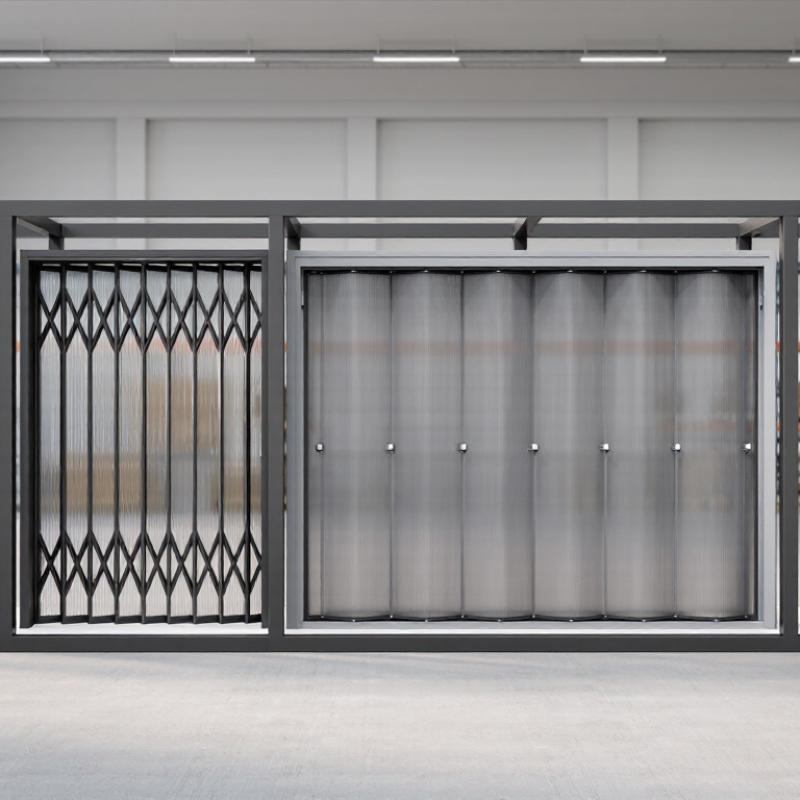
A folding mesh door is a flexible insect screen that opens and closes along a side track. Unlike a hinged screen door, it does not swing into a room or walkway. The mesh folds into narrow pleats when opened. When pulled across the frame, it creates a ventilated barrier against mosquitoes, flies, and light dust. No complicated mechanism is required. Magnetic strips, top guides, or locking edges may help keep the screen closed.
Common types include pleated, accordion, retractable, single-panel, and double-panel designs. Pleated mesh suits balconies and wide windows because it stores compactly. Accordion models often use stronger side frames for frequent movement. Retractable screens roll into a housing, leaving a cleaner opening when unused. Double-panel doors work well for patios and broad entrances. Each design has limits. A fine mesh may improve insect control but reduce airflow slightly.
During installation checks, frame alignment matters more than many buyers expect. A small gap at the bottom can allow insects inside. Uneven floors may require an adjustable guide or a custom threshold. For humid regions, corrosion-resistant hardware deserves attention. In dusty areas, the track needs easy cleaning. I have found that users often choose appearance first, then regret weak handles or loose mesh. The best choice depends on opening width, traffic frequency, local weather, and repair access. It is not a perfect barrier. Careless operation can still damage the folds.
| Folding Mesh Door Type | What It Is | How It Works | Typical Opening Range | Common Mesh Materials | Best-Fit Applications | Key Buying Considerations |
|---|---|---|---|---|---|---|
| Single-Panel Pleated Screen Door | A pleated insect screen that covers one doorway and folds into a compact stack at one side. | The screen slides horizontally through a top track and a floor guide. The pleats compress when the door is opened. | Approximately 600–1,200 mm wide and 1,900–2,400 mm high per panel. | Fiberglass Polyester Aluminium mesh | Residential single doors, balconies, bedrooms, patios and narrow terrace openings. | Check installation depth, track clearance, pet resistance, pleat width and whether the bottom guide is suitable for accessibility. |
| Double-Panel Pleated Screen Door | A center-opening screen made from two pleated panels for wider entrances. | Each panel slides toward its side track and meets at the center when closed. Both panels fold into side stacks when opened. | Approximately 1,200–2,400 mm wide and 1,900–2,600 mm high overall. | Fiberglass Polyester Aluminium mesh | French-door openings, wide balconies, patio entrances and residential folding doors. | Confirm center alignment, panel tension, locking arrangement and the structural condition of the head and side frames. |
| Accordion Mesh Door | A multi-panel flexible screen or lightweight mesh partition with wider folds than a pleated screen. | Linked panels move along a top-hung or top-and-bottom track and concertina into one or both sides. | Approximately 1,000–4,000 mm wide and 2,000–3,000 mm high, depending on panel construction. | PVC-coated polyester Vinyl mesh Fiberglass | Large interior openings, verandas, kiosks, seasonal partitions and light-duty commercial areas. | Evaluate panel rigidity, track load, wind exposure, cleaning requirements and the available stacking space. |
| Magnetic Folding Mesh Screen | A lightweight flexible mesh screen that closes at a magnetic center seam and folds or gathers at the sides. | Users pass through the center seam; magnets reconnect the overlapping edges after passage. Side ties or hooks hold it open. | Commonly suited to openings of about 700–1,800 mm wide and 1,900–2,300 mm high. | Fiberglass Polyester PVC mesh | Rental homes, temporary screening, balconies, utility doors and low-cost residential projects. | Measure the opening accurately and check magnetic strength, seam overlap, mounting surface and resistance to wind and pet traffic. |
| Retractable Folding Insect Screen | A framed screen system that combines a pleated or folding mesh with a compact side cassette or housing. | The mesh extends across the opening on a guided track and folds into the cassette when retracted. | Approximately 600–1,500 mm wide per leaf and up to about 2,500 mm high, depending on the system. | Fiberglass Polyester Stainless-steel mesh | Premium residential windows, doors, balconies and projects requiring a concealed appearance. | Compare cassette size, replacement-mesh availability, guide-track design, UV resistance and long-term operating force. |
| Sliding-Folding Mesh Partition | A series of framed mesh panels that fold together while sliding along a ceiling-mounted or floor-supported track. | Panel hinges allow the leaves to fold; rollers or carriers guide the folded assembly along the track. | Approximately 2,000–8,000 mm wide and 2,000–3,500 mm high for modular systems. | Aluminium mesh Fiberglass PVC-coated fabric | Restaurants, hospitality areas, garden rooms, commercial terraces and large indoor partitions. | Check panel weight, track capacity, wind loading, corrosion protection, parking direction and emergency access needs. |
| Pet- and High-Traffic Folding Mesh Door | A reinforced folding screen designed for repeated passage and improved resistance to scratching or pushing. | Reinforced mesh, weighted bottom sections, magnetic closures or stronger side guides help the screen return to position after use. | Usually customized for openings of approximately 700–2,000 mm wide and 1,900–2,500 mm high. | PVC-coated polyester Heavy-duty fiberglass Metal mesh | Homes with pets, cafés, service doors, garden access points and frequently used residential entrances. | Prioritize tear strength, seam construction, bottom protection, replaceable sections and the door's behavior under repeated impact. |
| Heavy-Duty Industrial Folding Mesh Curtain | A flexible mesh barrier used to separate work areas while allowing airflow, visibility and pedestrian movement. | Reinforced mesh sections fold or slide on a suspended track, often with overlapping edges or a side-stacking arrangement. | Commonly engineered for openings about 2,000–10,000 mm wide and 2,000–6,000 mm high. | PVC-coated polyester Welded wire mesh Stainless steel | Warehouses, workshops, loading areas, food-processing spaces and ventilated industrial zones. | Verify fire behavior, chemical compatibility, hygiene requirements, wind pressure, track load, impact protection and local safety regulations. |