
Quality Products
At a Fair Price
Wholesale Provider
Of Valves & Fittings
- HOME
- Products
- Ball Valves
- Bull Plugs & Swages
- Butterfly Valves
- Check Valves
- Cushion / Flow Tees & Bleed Rings
- Enhanced Oil Recovery
- Floating Ball Valves
- Foot Valves
- Forged Steel Fittings
- Forged Steel Outlets
- Gaskets-Insulation Kits
- Gate Valves
- Gate, Globe & Check Valves
- Malleable Fittings
- Needle Valves
- Nipples
- Piston Valves
- Plug Valves
- Stainless Steel Flanges, Fittings & Nipples
- Strainers
- Studs
- Trunnion
- Unions
- Weld Fittings & Flanges
- Manufacturers
- Advance
- American Block
- Anvil
- Balon
- Bonney Forge
- Champion
- Clayton Mark
- Crane
- Daniel
- DMIC
- GMI
- Galli & Cassina
- Hackney-Ladish
- JMC
- Lone Star
- MATCO
- Marpac-McCanna
- National Flange
- National Gasket
- Nordstrom
- Nutron
- PPI
- SHARPE
- SMI
- TEXSTEAM
- TEX-THREAD
- Titan
- USA Fastner
- Vogt
- Weld Bend
- Westbrook
- Wheatley
- Williams
- WKM
- Wolar
- Locations
- Contact
- Blog
- Careers
- Get a Quote
- HOME
- Products
- Ball Valves
- Bull Plugs & Swages
- Butterfly Valves
- Check Valves
- Cushion / Flow Tees & Bleed Rings
- Enhanced Oil Recovery
- Floating Ball Valves
- Foot Valves
- Forged Steel Fittings
- Forged Steel Outlets
- Gaskets-Insulation Kits
- Gate Valves
- Gate, Globe & Check Valves
- Malleable Fittings
- Needle Valves
- Nipples
- Piston Valves
- Plug Valves
- Stainless Steel Flanges, Fittings & Nipples
- Strainers
- Studs
- Trunnion
- Unions
- Weld Fittings & Flanges
- Manufacturers
- Advance
- American Block
- Anvil
- Balon
- Bonney Forge
- Champion
- Clayton Mark
- Crane
- Daniel
- DMIC
- GMI
- Galli & Cassina
- Hackney-Ladish
- JMC
- Lone Star
- MATCO
- Marpac-McCanna
- National Flange
- National Gasket
- Nordstrom
- Nutron
- PPI
- SHARPE
- SMI
- TEXSTEAM
- TEX-THREAD
- Titan
- USA Fastner
- Vogt
- Weld Bend
- Westbrook
- Wheatley
- Williams
- WKM
- Wolar
- Locations
- Contact
- About
- Careers
- Get a Quote
2026 Top Three Phase Diesel Generator Buying Guide
Choosing a Three Phase Diesel Generator in 2026 means matching real operating demands, not just comparing prices. A machine that looks powerful on paper may struggle when pumps, compressors, and motors start together. Check the required voltage, frequency, running load, and starting current before reviewing models. Leave suitable capacity for future equipment, but avoid oversizing without a clear reason. Bigger is not always better.
Small details matter. A control panel should be readable in poor light, and service access should allow routine checks without awkward disassembly. Compare fuel consumption at expected loads, not only at full output. Ask about spare-parts availability, warranty coverage, cooling requirements, and documented service intervals. These questions reveal practical differences between similar-looking sets.
This guide explains how to assess output, phase balance, engine and alternator specifications, fuel use, noise, installation needs, and supplier support. It also highlights common purchasing gaps, including overlooked starting loads and limited maintenance access. A site survey and advice from a qualified generator technician can help verify the final specification. Even careful planning has limits; actual performance depends on site conditions, connected equipment, and maintenance. Use the guide as a sound starting point, then confirm the details against manufacturer data and your operating needs.
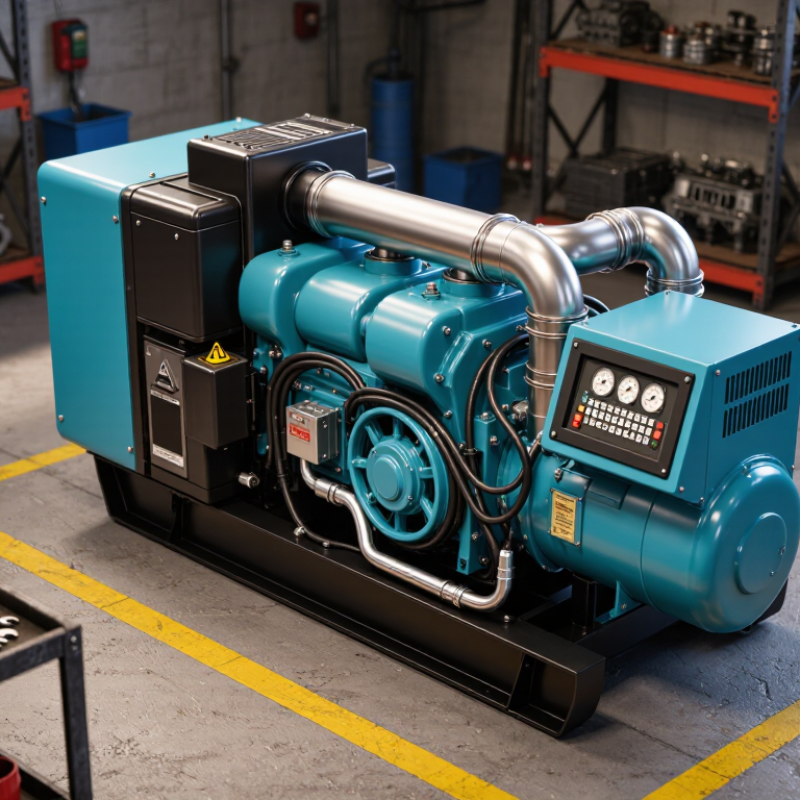
Understanding How Three-Phase Diesel Generators Work
A diesel engine converts fuel energy into rotation. Its crankshaft drives an alternator, where a rotating magnetic field induces voltage in stationary copper windings. In a three-phase alternator, three winding groups are spaced 120 electrical degrees apart. Their outputs form three alternating currents, each reaching its peak at a different moment. That matters. The combined supply can deliver power smoothly to motors and other suitable equipment.
Generator frequency depends on engine speed and alternator pole count. A governor adjusts fuel delivery when the load changes, helping maintain speed and frequency. An automatic voltage regulator controls excitation to keep voltage within its operating range. Three-phase equipment connects across the phases, while some systems also provide a neutral for single-phase loads. Check the generator’s wiring diagram before connecting equipment.
Load balance deserves attention. A large motor starting beside smaller single-phase devices can create uneven phase currents and a brief voltage dip. Small differences add up. Compare the expected running and startup loads with the generator’s rated kW and kVA, and account for the load’s power factor. In practical installations, loads are rarely perfectly balanced, so measure phase currents during operation. That simple check can reveal a problem before overheated cables or unreliable equipment do.
Calculating Your Power and Load Requirements
Before choosing a three-phase diesel generator, list every load it may need to support. Record each machine’s rated kW or amps, voltage, and phase from its nameplate. Include lights, pumps, compressors, and control equipment. Small loads add up.
Then identify which motors start together. A motor can briefly draw several times its normal current, so its starting demand may matter more than its running watts. Check the manufacturer’s starting-current data where available. Add the running loads expected to operate at the same time, then account for the largest likely startup. Do not simply add every nameplate maximum if the equipment will never run together.
Three-phase balance matters. Divide single-phase loads across the phases as evenly as practical, and ask a qualified electrician to check the proposed arrangement. Uneven loading can limit usable generator capacity. Also confirm whether the equipment is specified in kW or kVA; power factor affects the relationship between them. Leave reasonable headroom for changing loads, but avoid sizing far beyond actual demand. Oversizing can mean unnecessary fuel use and inefficient operation at light loads. I still find one detail easy to overlook: future equipment. A short load log from a typical workday can reveal what estimates miss. Check it before ordering.
2026 Top Three Phase Diesel Generator Buying Guide: Calculating Your Power and Load Requirements
Example balanced three-phase load estimate for a small industrial site. Values show the expected running demand of each load in kilowatts (kW).
Example sizing: The loads total 75 kW. Adding a 25% planning margin gives 93.75 kW, so a generator rated around 100 kW is a reasonable starting point. At 0.8 power factor, 100 kW corresponds to 125 kVA. Confirm motor-starting requirements, load balance, site conditions, and the generator’s kW/kVA ratings with a qualified supplier before choosing a set.
Comparing Generator Ratings, Engines, and Features
A three-phase diesel generator should be compared by its rating, not just its largest kilowatt figure. ISO 8528-1 distinguishes emergency standby power from prime power, which supports extended operation under varying loads. Confirm the rating against your actual duty cycle. A standby unit may be unsuitable for routine power supply, even when its headline output looks sufficient. That gap matters. Leave room for motor starting, future equipment, and uneven phase loading; a workshop’s compressors can create brief, sharp demand spikes.
Compare engines using fuel consumption at several load points, not only full load. Check cooling capacity, service intervals, low-load operating guidance, and response to sudden loads. The U.S. Energy Information Administration’s 2022 reliability data reported average customer interruptions of 5.6 hours when major events were included, versus 2.3 hours without them. Those figures describe grid reliability, not a site-specific outage forecast, but they help frame backup-runtime planning. Also compare alternator insulation, voltage regulation, controller alarms, sound enclosure, and transfer-switch compatibility. Ask for test results at 25%, 50%, 75%, and 100% load. One detail is easy to overlook: fuel use and performance can change substantially with load, ambient heat, and altitude. I would verify the conditions behind every quoted figure before choosing.
2026 Top Three Phase Diesel Generator Buying Guide - Comparing Generator Ratings, Engines, and Features
| Comparison | Compact Set | Mid-Range Set | High-Capacity Set |
|---|---|---|---|
| Typical rating class | 20 kVA prime / 22 kVA standby | 100 kVA prime / 110 kVA standby | 500 kVA prime / 550 kVA standby |
| Approximate output at 0.8 power factor | 16 kW prime / 17.6 kW standby | 80 kW prime / 88 kW standby | 400 kW prime / 440 kW standby |
| Representative 50 Hz electrical output | 400/230 V, three phase, 1500 rpm | 400/230 V, three phase, 1500 rpm | 400/230 V, three phase, 1500 rpm |
| Typical engine configuration | Four-cylinder diesel engine, often around 2–3 L displacement | Six-cylinder turbocharged diesel engine, often around 6–8 L displacement | Six- to twelve-cylinder turbocharged diesel engine; displacement commonly varies widely by design |
| Common cooling and starting features | Radiator cooling; electric starter; battery and charger often supplied or available | Radiator cooling; electric starting; automatic-start controls commonly available | Heavy-duty radiator cooling; electric starting; jacket-water heating and redundant battery arrangements may be specified |
| Alternator and control features to check | Brushless alternator, automatic voltage regulation, overload protection, basic digital metering | Brushless alternator, AVR, configurable protection, load monitoring, automatic transfer switch compatibility | Brushless alternator, AVR, advanced protection and metering, synchronizing or paralleling capability when specified |
| Best suited to | Small commercial premises, workshops, and essential backup loads | Medium facilities, larger commercial buildings, and grouped equipment loads | Large facilities, industrial sites, and installations with substantial or multiple loads |
| Buying considerations | Check motor-starting demand, phase balance, noise limits, and access for maintenance. | Assess load steps, expansion plans, fuel storage, exhaust routing, and transfer equipment. | Review load studies, site infrastructure, ventilation, emissions requirements, and commissioning needs. |
Rating note: Prime power is intended for variable loads under the rating standard and operating limits specified by the manufacturer. Standby power is generally reserved for emergency use during utility outages and is not intended as a continuous prime-power rating. The example standby values shown are illustrative; available ratings and permitted operating hours vary by generator design and applicable standard. At 60 Hz, engine speed and standard output voltage commonly differ, so confirm the required frequency, voltage, power factor, and rating definition before purchase.
Evaluating Fuel Use, Installation, and Maintenance
2026 Top Three Phase Diesel Generator Buying Guide
Evaluating Fuel Use, Installation, and Maintenance
Fuel use depends on load, not just the generator’s rated output. The U.S. Energy Information Administration lists diesel at about 137,381 Btu per gallon. That figure helps compare energy, but it cannot predict a set’s hourly consumption. Ask for the manufacturer’s fuel curve at 25%, 50%, 75%, and full load. A site running motors near half load may burn differently from one with frequent starts and sharp peaks. Keep a simple log of runtime, load, and refueling. It may reveal a mismatch.
Installation details matter. Three-phase equipment needs correctly sized conductors, overcurrent protection, grounding, and a transfer arrangement suited to the site. Leave room for airflow and service access; a unit squeezed behind a fence can run hot and frustrate repairs. Check exhaust direction, fuel storage, noise limits, and local permitting before pouring a pad. NFPA 110 offers guidance for emergency and standby power systems, but site requirements vary. Have a qualified electrical professional verify the design.
Tips: Compare fuel curves, not headline ratings. Keep the load within the generator’s recommended range. Record oil changes, filter replacements, coolant checks, and test runs against the maker’s maintenance schedule. Intervals vary by model and duty cycle, so a generic calendar is only a starting point. Small oversight happens. Note unusual smoke or vibration, then investigate before the next outage.
Choosing a Reliable Generator for Your 2026 Needs
Start with the loads, not the largest rating on a sales sheet. List running watts and starting demand for motors, pumps, compressors, and other equipment. Then check whether loads are balanced across all three phases; uneven demand can cause overheating or unstable voltage. Leave room for future additions, but avoid oversizing without reason. That matters.
Ask for the correct duty rating, since standby and continuous operating needs are not interchangeable. Confirm output voltage, frequency, and starting capacity against equipment nameplates. At a site visit, note ventilation, exhaust routing, service clearance, and distance to the electrical connection. Noise travels. Fuel storage and routine filter, coolant, and battery checks also affect readiness.
Request documented load-test results and a clear maintenance schedule before purchase. Those records give you something concrete to compare. Include expected runtime and site conditions in your estimate. Even careful sizing can miss a rarely used pump or a cold-weather start; revise the load list after operators review it.
