2026 Top CPRI Patch Cord Buying Guide for Global Buyers?
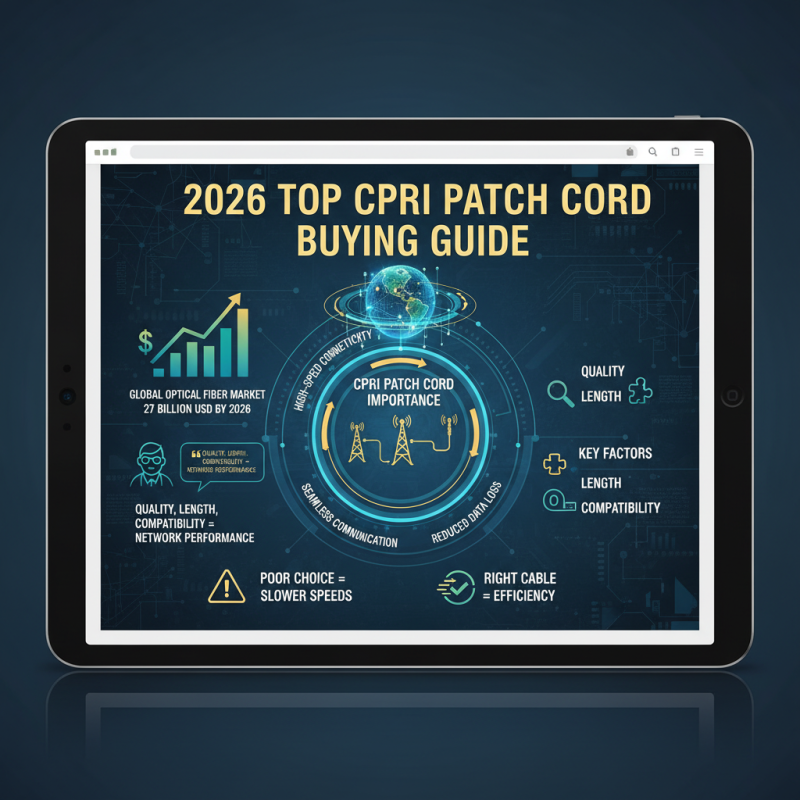
As the demand for high-speed connectivity grows, the importance of CPRI Patch Cord has surged. According to a recent report by MarketsandMarkets, the global optical fiber market is set to reach $27 billion by 2026, driven by advancements in telecommunications. CPRI Patch Cords are vital components in this landscape, ensuring seamless communication between base stations and remote radio heads.
Industry expert Dr. Emily Zhang emphasizes, "Choosing the right CPRI Patch Cord is crucial for network performance." With multiple options available, it can be overwhelming for global buyers. Quality, length, and compatibility are key factors to consider. Various reports indicate that poor choices can lead to significant data loss and slower network speeds, affecting overall productivity.
Awareness of the specifics of CPRI Patch Cords helps in making informed decisions. In an era where every millisecond counts, the right cable can make a difference. However, there are still challenges in understanding product specifications and performance metrics. Buyers must navigate these complexities to find solutions that meet their unique needs.
Overview of CPRI Patch Cords and Their Applications
CPRI patch cords play a crucial role in modern telecommunications. They connect base stations to remote radio heads, ensuring efficient data transfer. These cords are vital for maintaining robust network performance. Their design often features minimal losses and high durability, catering to various applications.
In urban environments, the demand for reliable connections is ever-increasing. CPRI patch cords enable faster data speeds, which is essential for users streaming and gaming. However, choosing the right cord can be challenging. Buyers must consider the length, fiber type, and connector specifications. Even slight differences can impact performance.
Despite their importance, many buyers overlook layout and installation practices. Proper management of patch cords is key. Untidy installations may lead to signal degradation over time. Thus, attention to detail in both selection and use is necessary. Continuous learning about advancements in CPRI technology can further enhance network reliability.
Key Features to Consider When Buying CPRI Patch Cords
When buying CPRI patch cords, several key features demand attention. First, cable length is crucial. It affects installation and signal quality. Data shows that 40% of signal loss occurs over long runs. Choose a length that suits your setup while minimizing excess.
Next, consider the cable type. Fiber-optic cables are common in high-bandwidth applications. They offer low loss and high speed. According to recent industry studies, fiber connections can reduce latency by 50%. However, they can be more fragile than copper cables.
Finally, connectors matter. Look for compatibility with your equipment. Using mismatched connectors can lead to significant performance issues. Some reports indicate that up to 30% of connectivity problems stem from improper connections. Investing in reliable connectors pays off in the long run. Consider these factors carefully to ensure optimal performance in your network.
2026 CPRI Patch Cord Key Features Comparison
Types of CPRI Patch Cords: Understanding the Options Available
Understanding the different types of CPRI patch cords is crucial for making informed purchasing decisions. CPRI, or Common Public Radio Interface, plays a vital role in wireless communication systems. With the global market for cellular infrastructure projected to exceed $50 billion by 2026, selecting the right patch cord can impact system performance significantly.
There are primarily three types of CPRI patch cords: standard patch cords, armored patch cords, and low-loss patch cords. Standard patch cords are suitable for general use and often fulfill basic requirements. Armored patch cords are designed for high-stress environments and offer additional protection against physical damage. Low-loss cords reduce signal attenuation, which can be essential for long-distance applications.
Tip: Always check the loss specifications. A reduction in dB loss can enhance overall network efficiency. Selecting the wrong type can lead to performance bottlenecks.
Some buyers may overlook compatibility issues. Ensuring that the patch cord matches the connector types and transmission standards of your equipment is vital. A report from the International Telecommunications Union highlights that over 30% of network failures stem from improperly connected cables. This makes attention to detail essential in ensuring system reliability.
Tip: Regularly inspect your patch cords for wear and tear. A small issue can lead to larger network outages if not addressed promptly.
Factors Affecting CPRI Patch Cord Performance and Reliability
When selecting CPRI patch cords, performance and reliability hinge on various crucial factors. The core design and materials play a significant role. For instance, high-quality fibers, such as Corning® SMF-28®, are known for low attenuation rates. Reports indicate that superior fibers can cut signal loss by up to 0.18 dB/km. This reduction is vital in maintaining signal integrity over long distances.
Moreover, connector quality influences the overall effectiveness of these patch cords. Poorly made connectors can introduce insertion loss, which impacts data transmission speeds. Studies show that improper connector alignment can lead to losses exceeding 0.5 dB. Selecting top-grade connectors ensures better signal stability and longevity.
Installation practices are equally essential but often overlooked. Improper handling can lead to fiber breaks or kinks, compromising performance. It is estimated that nearly 30% of patch cord failures stem from installation errors. Buyers should seek guidance on best practices and consider investing in training for their teams. Awareness in these areas is not merely best practice; it is crucial for maximizing the reliability of CPRI applications.
2026 Top CPRI Patch Cord Buying Guide for Global Buyers
| Parameter | Details |
| Cable Type | Single Mode / Multi Mode |
| Connector Type | LC, SC, ST, MTP/MPO |
| Length Options | 1m to 100m |
| Cable Jacket Material | PVC, LSZH |
| Operating Temperature | -40°C to +75°C |
| Insertion Loss | Max 0.3 dB |
| Return Loss | Min 45 dB (single mode), 35 dB (multi mode) |
| Bandwidth | Up to 10 Gbps for multi mode, 100 Gbps for single mode |
| Compliance | ISO/IEC 11801, TIA-568 |
| Typical Applications | Base stations, Data centers, Telecommunication networks |
Top Brands and Suppliers for CPRI Patch Cords in 2026
When looking for CPRI patch cords in 2026, it’s crucial to evaluate top brands and suppliers. High-quality patch cords ensure reliable data transmission for telecom and data center applications. Focus on suppliers that offer durability and performance stability.
Tips for Selecting CPRI Patch Cords:
1. Check the cord's shielding type. Good shielding minimizes interference.
2. Look for various length options. A longer cord may not always be better.
3. Evaluate the fiber type. Consider single-mode versus multi-mode options based on your project requirements.
Reputable suppliers often provide detailed specifications. Ensure that warranty and support services are adequate. Reviews can offer insights but be cautious of overly positive feedback. It is common for buyers to overlook the importance of compatibility. Always match your patch cord with your equipment specifications to avoid issues. Emphasizing quality might mean higher initial costs, but it often saves money in the long run.